
The amount on your hospital bill is often not what your provider receives.
Insurance reimbursement rates, not medical need or clinical judgment, increasingly determine what care patients can actually access, particularly in rural areas. Fees are set so low that many independent practitioners cannot sustain a practice while accepting insurance at all.
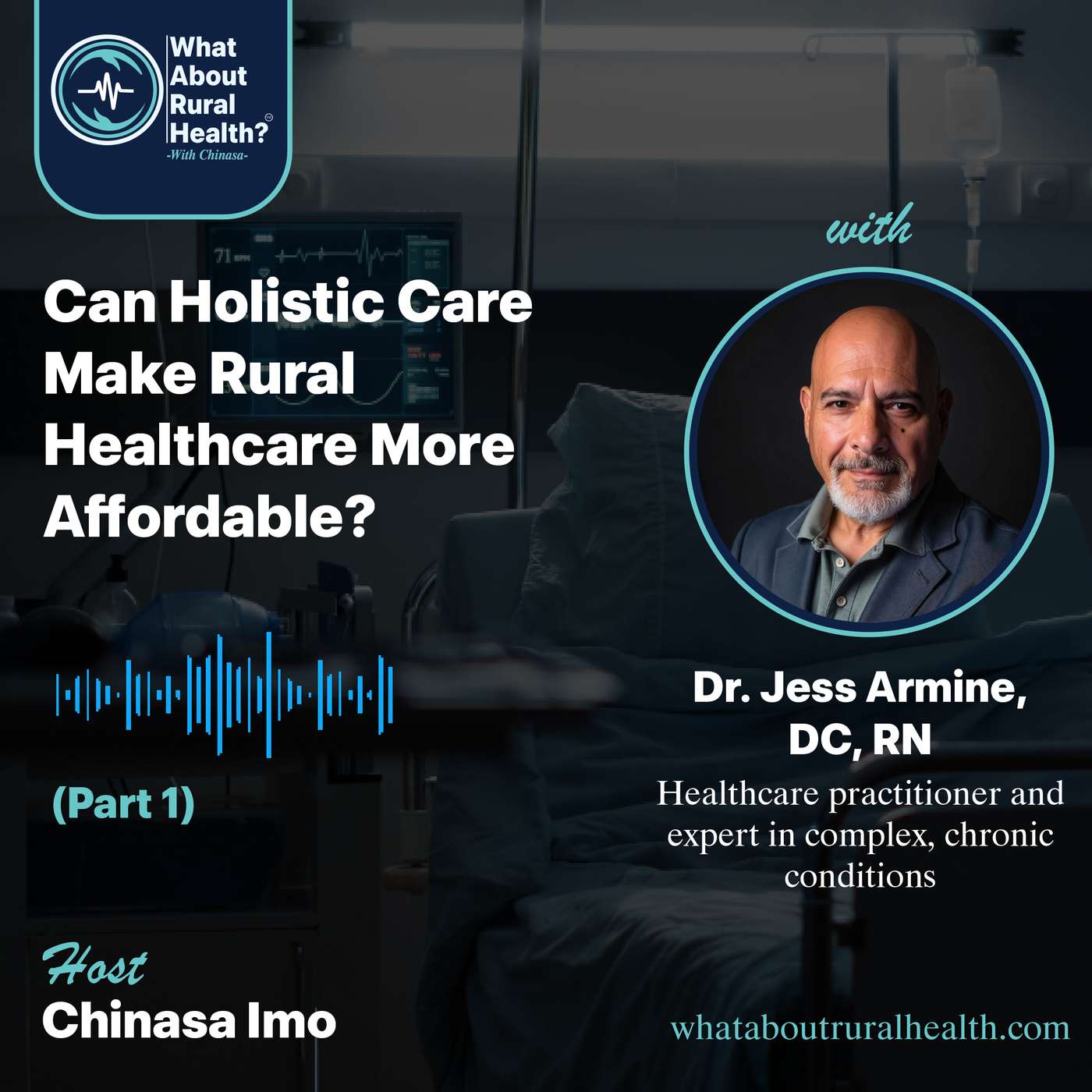
That is the picture Dr. Jess Armine lays out in a conversation with What About Rural Health. Armine has spent 50 years in healthcare, starting as an EMT and paramedic in New York City, then a registered nurse who ran a coronary intensive care unit as an Army nurse, then earned his chiropractic degree in 1986 before moving into functional and alternative medicine, where he now specializes in neuroendoimmunology.
What an Office Visit Actually Pays
For years Armine accepted insurance, but the math eventually made that impossible. Billed charges mean almost nothing once a claim reaches the payer. “I could charge a million dollars a minute for chiropractic manipulation but if the insurance company only allows 40, that’s what they’re going to reimburse,” Armine says of the gap.
At the highest complexity billing code for an office visit, 99205, insurers reimbursed him roughly $85 for a two-hour session, not counting the hour of prep beforehand or the hour of treatment planning after. The arithmetic is not abstract for a solo provider. “If I’m seeing one person at a time, if I can’t get reimbursed for my time, I can’t live,” he says.
“If I'm seeing one person at a time, if I can't get reimbursed for my time, I can't live”
Enjoying this article? Hear the full conversation with Dr. Jess Armine on What About Rural Health.
How Reimbursement Gets Compressed
The underpayment is not incidental. Armine describes an industry that has optimized reimbursement down to the smallest line item over years. “Tylenol, the hospital charge $10, but they’ll get reimbursed 50 cents,” he says. The same compression applies to imaging. MRIs that once cost $1,500 to $2,000 are now billed at a fraction of that to insurers, which Armine says explains why scan centers have stretched their hours. “The insurance companies are paying them $300 for an MRI, and that’s a reality,” he says, noting some centers now operate from 6 a.m. to midnight to make the volume work.
The business model, as Armine frames it, runs on collecting premiums while limiting what gets paid out. Patients still gravitate toward in-network care because it is what their coverage subsidizes, which narrows their choices to providers willing to accept compressed rates. In places where specialists are already scarce, that narrowing turns into an outright gap, with patients holding coverage but no nearby provider who accepts it.
Why Rural Patients Feel It Most
Nationally, the physician shortage is most acute outside metro areas: the Health Resources and Services Administration has designated thousands of rural areas as Health Professional Shortage Areas, and rural counties have consistently fewer physicians per capita than urban ones, per the Rural Health Information Hub. Low reimbursement gives independent and specialty providers another reason to opt out of insurance networks altogether, compounding the access gap with an affordability gap. As a result, rural patients are hit with higher premiums resulting from less insurance provider competition, as well as higher out-of-pocket costs.
Armine does not see the trend reversing on its own. “That is ingrained,” he says. “That has to change over.” Absent a shift in how insurers set and adjust reimbursement, more providers are likely to follow his path out of network participation, leaving patients with coverage on paper and fewer places to use it.
Want more conversations like this one? Subscribe to the What About Rural Health newsletter for new episodes, articles, and rural health financing insights.
Sources
- Rural Health Information Hub, “Healthcare Access in Rural Communities”
- HRSA, Health Professional Shortage Areas
More From This Conversation
- Full transcript: Holistic Care and Rural Healthcare Costs
- Listen to Part 1
- Listen to Part 2
- How Medicine Lost the Generalist Who Knew You
- The Cellular Root of Post-COVID Fatigue
- Dr GPT Is Always Ready to See You
- What Actually Works for the Rural Healthcare Gap
Editor’s note: The views in this conversation are the guest’s own and do not necessarily reflect those of What About Rural Health. This article is for information only. It is not medical advice. Please talk to a qualified health professional about your own care.