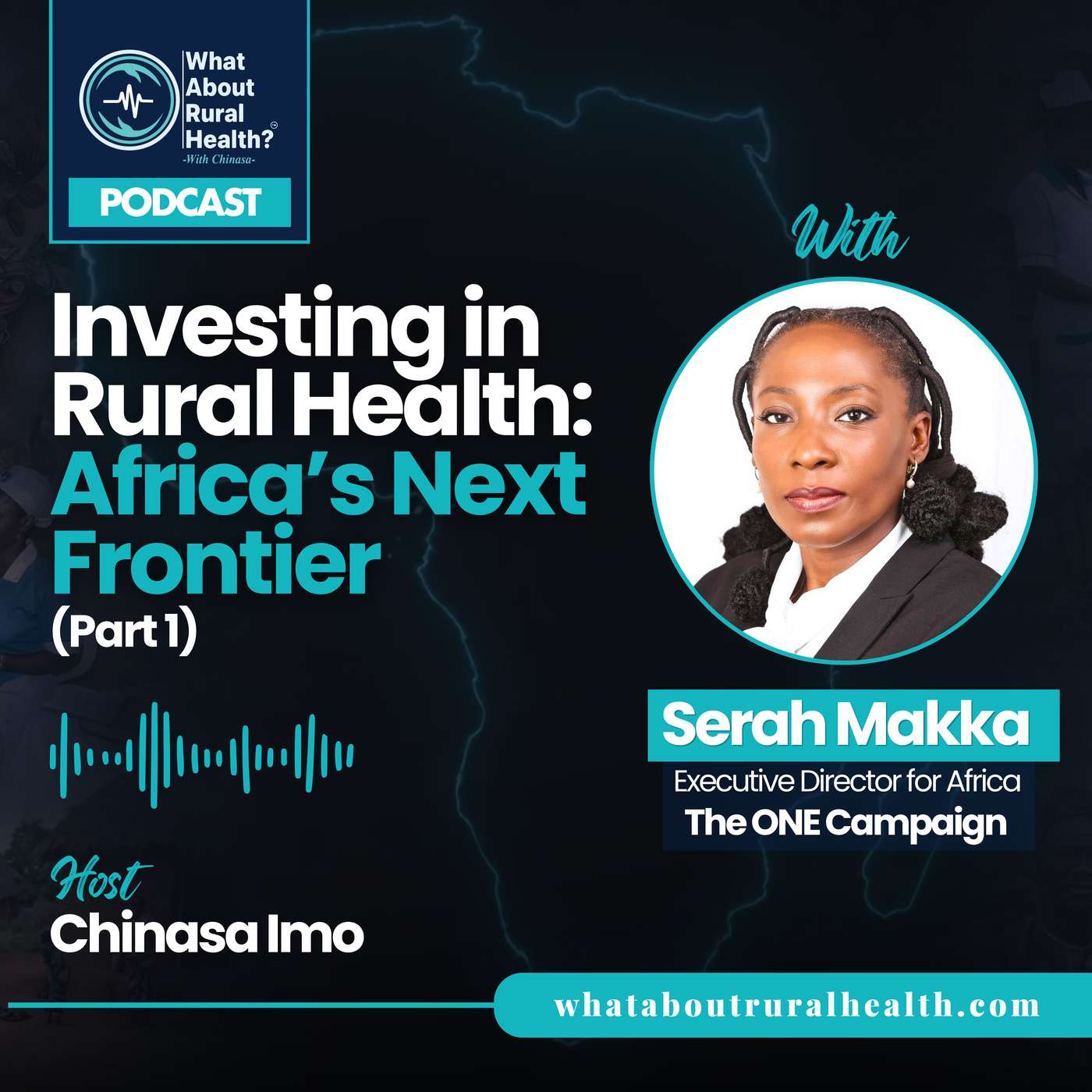
This is the full transcript of the What About Rural Health conversation between host Chinasa Imo and Serah Makka, Executive Director for Africa at The ONE Campaign, on investing in rural health in Africa. They cover how global health narratives overlook Africa’s contributions, why the aid and donor dependency model needs rethinking, domestic financing ideas such as diaspora-funded insurance and debt-for-health swaps, who pays for care today, and what makes rural health investable.
The episode aired in two parts. Listen to Part 1 and Part 2.
About the Guest and Host
Guest: Serah Makka
Executive Director for Africa, The ONE Campaign
Serah Makka is Executive Director for Africa at The ONE Campaign, with more than 20 years of experience in governance, advocacy and financial inclusion across Africa, Europe and the Middle East. She is a Desmond Tutu Fellow, a "Global Top 35 Under 35" honoree, and holds a master's in Public Policy from Harvard's Kennedy School. She serves on the boards of Advokc, Resilience Action Network Africa, and the Institute for Public Policy Research. Her work focuses on strategic advocacy for social and economic transformation across the continent, with particular attention to women, youth and underserved communities.
Host: Chinasa Imo
Host, What About Rural Health
Chinasa Imo is the host of What About Rural Health, a podcast uncovering the stories, challenges and innovations shaping healthcare in overlooked communities, asking how money moves, who gets funded, who gets served, and who gets excluded.
In This Episode
- Cold Open
- Introduction
- ~7:07 Global Health's Narrative Problem, and Africa's Uncredited Contributions
- ~16:54 Rethinking the Aid and Donor Dependency Model
- ~25:12 Domestic Financing Mechanisms: Diaspora Insurance, Debt Swaps and Health-Worker Deals
- ~36:53 How Rural Health Is Actually Financed Today
- ~48:38 Making Rural Health Investable
Cold Open
Serah Makka: Africa usually sends raw inputs out to the world to codify and build vaccines. We send these raw inputs for free, the world processes them into a vaccine, and sells it back to us. They don't acknowledge our contribution to the value chain of the vaccine manufacturing process. But increasingly, we just don't have the leverage to negotiate well for Africa. So one of the things we're trying to do more and more is help Africans understand that the world's global system doesn't necessarily lend itself to A, good news from Africa, B, understanding how Africa is actually set up, or C, giving us credit for where we contribute, and making sure we have financial remuneration that matches our contribution. Africa just needs to stand up and speak for itself, collectively.
Introduction
Chinasa Imo: Hello and welcome. This is What About Rural Health, the podcast that asks the question too many people forget: what about rural health? I am your host, Chinasa Imo, and together we are uncovering the stories, challenges and innovations that are shaping healthcare in overlooked communities. In this series we ask questions about how money moves, who gets funded, who gets served, and who gets excluded. From policy to practice, we explore what healthcare financing should look like for everyone.
When we talk about health in Africa, the conversation almost always starts from a place of lack: lack of infrastructure, lack of workforce, lack of funding. And yes, those challenges are real. Roughly half of the continent's population lives in rural areas, and I personally suspect that figure may even be undercounted, because statistics like this often overlook border and periphery spaces. But even taking the number at face value, it means half the continent is navigating a healthcare system where quality access isn't guaranteed. Limited health workforce, infrastructure and financing stay concentrated in urban centers, and rural communities keep facing higher maternal mortality risk, limited access to specialist care, fragile supply chains and persistent structural inequality.
What's frustrating about this reality is that rural health gets consistently framed through a lens of scarcity, deficit and burden. Humanitarians, donors, sometimes even we ourselves, frame it as a beneficiary or cost-driven program. Investors call it volatile. Program people talk about operational difficulty. Governments call it costly, complex or simply too risky. But what if we reframed the problem? Step back and look closely, and rural health can actually be a powerful investment frontier, one with implications for research and development, for workforce innovation, for digital health expansion, for public health security, and even for scientific discovery. Rural health systems sit at the front lines of disease surveillance, at the intersection of climate impact, health technology and population growth dynamics across the continent, some of the most important transitions happening in public health today.
So let's begin to see rural health not as a nice-to-have social project, but as an aggregate investment ecosystem, where the narrative shifts from charity to strategy, and from deficit to opportunity. That's exactly what today's conversation is about. We want to intentionally remove the deficit framing from rural health, and my guest is the perfect person to help me dig into this.
My guest today is Serah Makka. Serah brings two decades of experience in development finance and policy, working across Africa, Europe and the Middle East on finance, financial inclusion, technology, policy and strategic philanthropy. She currently serves as Executive Director for Africa at The ONE Campaign, where she leads advocacy focused on advancing investments that create opportunity and improve health outcomes across the continent. Serah is widely respected for amplifying African voices in global policy conversations, and for her work on sustainable financing, innovation and accountability in development and health systems. It's a real privilege to have you here. Welcome to What About Rural Health, Serah.
Serah Makka: Thank you for having me for this conversation, Chinasa.
Chinasa Imo: You're welcome. So let's dive in, how are you today?
Serah Makka: Today I'm doing pretty okay. It's a very warm day in Abuja, Nigeria, where I'm sitting. I just picked my little one up from school, so in the middle of it all, but doing okay. Thank you for making time.
Chinasa Imo: Thank you for making time to come. So let's dive in.
Global Health's Narrative Problem, and Africa's Uncredited Contributions (~7:07)
Chinasa Imo: When you look at how health financing is discussed globally, what narrative about health in Africa do you feel needs to change?
Serah Makka: There's a broader conversation happening about health generally, and I think you don't need to look further than the last few years, when COVID hit the world, to see it play out. COVID was a common ailment everyone around the world felt, but it was one that Africa didn't have as many resources to address: ventilators, PPE, vaccines, we lagged on all of it. And yet Africa did better than most of the world through that period. For reasons known and unknown, I think in many ways it stemmed from our responses to crisis over the years, that allowed us to respond better than many other places. But the conversation didn't rest there. People scratched their heads over how Africa wasn't as impacted, and the honest answer is a combination of things, including that we weather storms well and the people on the continent are resilient, even where the systems themselves aren't as resilient. Some x factor people are still trying to identify. It goes to show that when it comes to Africa, the rest of the world tends to lead with the narrative of poverty and pestilence.
I was in Sierra Leone last year when mpox hit. Within a month, the country had stopped its spread from moving on to other places, but that didn't make the news. Sierra Leone stopping mpox in its tracks didn't make headlines. Imagine if it had been Ebola spreading instead, that would have caught every headline. The world wants to lean on Africa's news when it's negative. It doesn't want to amplify Africa's news when it's positive. And the truth is, we have negative things that occur, but we also have positive things that occur, and healthcare gets the broader brunt of that skew.
There are also systemic things that keep Africa almost always holding the short end of the stick. During the pandemic preparedness treaty negotiations, I found out a few disturbing things: Africa usually sends raw inputs out to the world to codify and build vaccines. We send these raw inputs for free, the world processes them into a vaccine and sells it back to us, and doesn't acknowledge our contribution to that value chain. Increasingly, we just don't have the leverage to negotiate well for Africa. So one of the things we're trying to do more and more is help Africans understand that the global system doesn't naturally lend itself to good news about Africa, to understanding how Africa is actually set up, or to giving us credit and the financial remuneration that matches our contribution. Africa needs to stand up and speak for itself, collectively, because country by country we're just not as powerful and don't have the same leverage as when we come together as a continent. So while the narrative skews negative and the reality is mixed, there's still work for us to do, both to redress the systemic injustice that's been done, and to take our own agenda into our hands and fight for what we deserve.
Chinasa Imo: I love the perspective you brought to that. I was reading a book recently by a cardiologist from the University of Michigan describing the US health system and its technological innovation, and the author was making the case that the American health system is costly because it leads all this innovation, and because America's economy is large, it sells that innovation at high cost domestically, and then, with the profit made there, can afford to do good in places like Africa that can't pay for it themselves. That frustrated me, because my question back is: who creates this narrative? It's obvious in how the global health infrastructure has positioned itself, the global north as the do-gooder sending things down to the south to make it look like these things are delivered for free.
But you're actually saying something important too, you can't deliver something as innovative as a vaccine if you don't have the data and the specimens that come from the actual laboratory processes needed to understand it. I remember writing last year about the malaria vaccine, making the case that the difficulty in getting a unified vaccine is that the virus doesn't trace to a single pattern or viral load. Then someone argued the opposite: why is this vaccine even relevant to Nigeria, when they didn't even use data from Nigeria to build it? So bringing that back to you: when we look at those two narratives, one arguing the global north's innovation still depends on the global south's data and inputs, and one questioning whether that contribution was ever properly credited, how would you position that tension against the African narrative itself?
Serah Makka: When you're looking at a challenge, there are usually multiple sides to it. Let's take a step back and look at how the global health infrastructure was actually built. It was built for economic advantage. It wasn't originally about the individual who's sick or the disease itself, it grew out of port quarantining, so that when goods moved from Europe to the Americas or within Europe, ports had to quarantine to keep disease from spreading. That's how global health began.
It was really between the 1950s and 1960s, as newly independent African countries and Latin American countries started joining that global health infrastructure, that the framing shifted, and it became about solidarity and social welfare rather than a purely economic imperative. I think that shift lines up with something in African culture too, we take care of each other, it's ingrained, economics matters but it matters less than the people at the center of our solutions. It was the voices of the global south that pushed for that shift from an economic imperative to a social welfare one. And so the mindset coming in became "let's help each other." But the newly liberated countries coming into that system didn't hold the financial power, that rested with the countries that had been doing these economic things for much longer, Europe and North America. So giving became framed as, we have more, so let's share and help.
Enjoying this conversation? Hear the full episode with Serah Makka on your favorite podcast platform.
Rethinking the Aid and Donor Dependency Model (~16:54)
Serah Makka: But I don't think African countries have helped this narrative either. I actually have a vision for Africa becoming a donor continent. I'm tired of receiving. I want all 54 countries to be rich enough to give to the rest of the world, because being a recipient constantly reinforces a narrative of weakness, lack of agency, inability. I remember when Nigeria was supposed to graduate off Gavi support around 2018, moving into middle-income status, and the case being made was actually against graduating. Moves like that harden a narrative of constant receiving. I understand the allure of getting funding from others so you can spend your own money elsewhere, but in some ways, by not letting countries graduate when they could have, we reinforce the neediness we portray.
And I think there's a whole system in the west that's built to encourage that kind of giving. Sometimes when gifts or funds are given, there are strings attached, you must use certain products, and by the time you trace how much actually reaches the real people and communities being served, you find a lot has eroded along the way because of those strings. No gift comes for free. I don't think every country has an incentive to help Africa give to the rest of the world instead of receive, and I don't think that's really their job, it's ours. So how do we get out of this pattern? I think it's structural, and it's evolved over time: it was reinforced by the current state of many countries' economies, by Africa collecting and collecting, and by a system that benefits from giving. But at the end of the day, we need to find out how to sustain financing for Africa's health, by Africans. Until that's done, we're not really in charge of our own healthcare.
Chinasa Imo: Two things jump out at me there, and I agree with your vision. In academic and political spaces, I've said it's high time we start looking at African development differently, not as extremely poor countries that can't speak for themselves. When USAID funding was cut, I actually said that decision, painful as it was, was long overdue, because I'd done some research with a friend trying to trace where USAID money actually goes. Roughly 80 percent goes back to the principal countries, maybe 20 percent reaches the actual beneficiary countries, and even within that 20 percent you're still counting local operational costs before you get to actual program delivery. I'm not saying that aid doesn't do good, especially for countries coming out of economic trouble, but when you look at who's really being helped, it isn't primarily the countries it's meant for. So I agree Africa needs true financing, and I think we're starting to see that shift happen.
The second thing that jumped out is what you called the welfare state framing of global health. There's a lot of conversation, especially here, about who pays for healthcare, because healthcare is costly, and the instinct is often, just make sure it's free for us. I'm a social worker by training, so I understand what that framing means. But when we sit that heavily in a welfare-state mindset, nobody really holds anybody accountable, because there's no clear investment infrastructure behind it. So I agree with you, and that shift is what I want to ask about next. Delivering healthcare is costly, that's a real argument too, in making it affordable for the people who need it, it takes a mix of models, economic and otherwise, social enterprise structures included. What do you think needs to happen domestically, within the continent and among countries, for that narrative to shift toward a real enterprise infrastructure?
Serah Makka: There's a saying that you should never waste a good crisis. Whether it's the pulling out of funding or the drying up of healthcare aid, the data shows healthcare funding had been declining for fifteen years, and only spiked in 2020 because of COVID. Look at the trajectory over time and it was heading downward for fifteen straight years, so it was already hitting a kind of rock bottom before the crisis even hit. I love the word "reimagine," that's literally what we're doing at The ONE Campaign. The question we're trying to answer is: what does it look like when Africa funds its own healthcare and drives its own agenda?
We also know the context: many countries are at risk of debt distress post-COVID, supply chains are still recovering, and African countries haven't quite gotten a break. Africa is the most expensive place in the world to borrow money. When you borrow at high interest, you're paying for that money for many years, and paying more to service the debt than you have room to invest anywhere else. So development stagnates and slows. Right now, thirty countries spend more servicing debt than they invest in education or health combined, and they don't have a choice, if they don't service that debt, their credit rating gets hit and they become an economic pariah. So countries try everything before admitting they can't do it: laying off teachers, laying off healthcare workers, whatever it takes, just so they don't default. That's the picture we're in, a tight fiscal space, while we're also asking governments to do more. So where's the money going to come from? A few ideas we're working on right now.
Domestic Financing Mechanisms: Diaspora Insurance, Debt Swaps and Health-Worker Deals (~25:12)
Serah Makka: One is what we're internally calling health bridge, a diaspora-funded insurance model. Insurance is a strong lever right now for two reasons. First, if you pool risk, you reduce the cost of care, that's the whole model of insurance. Second, we need to find financing for that reduced cost that doesn't run through government. So we're looking at how, in countries like Nigeria and Kenya, diaspora remittances already dwarf official development assistance, foreign direct investment, and sometimes even national budgets, but that money moves one to one. I send money to my sister, sometimes to help her pay a hospital bill after surgery. It's a mountain of money moving, but transactionally.
Imagine instead I buy my sister health insurance where she lives, so that when she needs surgery, her cost of care is already lower. We're not saying stop sending money to your sister, we're saying route some of it through insurance instead of a one-off medical bill, because the medical bill model isn't sustainable. That remittance money would enter an insurance pool, and because someone's paying into it, we can find ways for the diaspora to effectively cover more than just their own relative, maybe your contribution also covers someone who doesn't have a sister abroad sending money home. We're actively working on a diaspora insurance product right now. I'm excited about it because it gives countries a bridge. Sierra Leone, for example, used to have around 300 free products in its free healthcare basket, funded mostly by donors including USAID. As that funding pulled back, they're left with a gap of roughly 180 products they now have to fund themselves. If those products became insurance-eligible and properly priced, people could still access them at more affordable rates than before.
The second mechanism is looking at debt profiles. Many countries are carrying heavy debt, and there's an opportunity to do what's called debt-for-health swaps. Say a country owes money to a lender, instead of asking for the debt to simply be forgiven, the country partners with the lender: I'll pay fifty percent of what I owe, and the other fifty percent gets redirected into strengthening my own health system. That's a debt-for-health swap, taking debt obligations and converting a portion of them into direct investment in a specific area, because right now that money is just going toward servicing debt with no return.
The third is around health workers. Africa is young, Europe is aging, the rest of the world is aging. Africa trains excellent health workers, at more affordable rates, and can train more of them than the rest of the world can. The problem is the health system those workers operate within leaves a lot to be desired, so many migrate to better-resourced systems elsewhere. I remember during COVID, a plane landed from the UK specifically to recruit nurses and doctors. Kenya has memoranda of understanding with the UK, Italy, Germany, many countries actively recruit African health workers. Health workers shouldn't be a liability on the African balance sheet, they should be an asset we can structure financial instruments around.
If I train thirty thousand nurses and twenty thousand of them are needed elsewhere, because frankly my own system can't fully absorb and retain them, we should be structuring formal, sovereign-to-sovereign deals: twenty thousand nurses can go, and the receiving country pays for it, and protects them from exploitation while they're there. That funding isn't just compensation for the individuals leaving, it should also fund two other things: upgrading my own health infrastructure, and expanding my training pipeline, so I can train forty thousand more nurses, with the cost of training those replacements also covered. The government shouldn't just be acting as a recruiting agency, it should be negotiating a deal where the country supplying the workforce is also paid to build capacity. That's the kind of deal African countries should be making with the rest of the world, because we have the leverage: the people, the training capacity, and a domestic unemployment challenge that makes it a win for everybody, if it's structured. Right now it mostly happens informally, one nurse at a time, one doctor at a time, and the country gets none of the benefit from what's effectively a structured brain drain, with many of those workers exploited along the way. It needs to become a structured conversation, government has to be involved, but done right, it's a real revenue source, and something we're excited to help governments think through, we have a framework for how it could work. Nigeria has a migration policy, but it needs to turn brain drain into a positive, revenue-generating stream for the country. There are many ways to structure it: workers go abroad for a set number of years, return home, mentor the next cohort, upskill others with what they've learned, so it's not a permanent departure but something more circular.
Africa doesn't have much leverage across the board economically, we contribute a small share of global trade, but there are specific things where we do have leverage: critical minerals, health workers, anything the world needs where we can act with something close to a monopoly. But we can't exercise that leverage country by country, we need a regional and continental standard. China is one country with 1.4 billion people speaking with one voice. Africa also has around 1.4 billion people, but split across 54 countries, and we can't win an argument against a single country that can speak with one voice with the same numbers behind it. The more Africa understands what's at stake in acting collectively, the better off we are, across every corner of rural health, urban health, everything that needs resourcing.
Chinasa Imo: I agree, and one thing that stands out is remittances specifically. There's been a lot of conversation, even in US policy circles last year, about capital flight tied to money people send abroad. So I'm glad countries are starting to pay attention to this, and if this has been a long-standing tradition, why not reshape it in ways that keep our people's money working for them. I like this as a novel model, and I'm glad we're having this conversation, because it's something we should embrace, given how large our populations are across different diasporas.
Before we move on, I want listeners to sit with this: when we say rural health, most people immediately picture primary care delivered in clinics. But this conversation shows the rural health system is broader than that, it's a systems-level issue, not just a geographic or facility question. Think about your own community, what does meaningful rural health access actually look like there?
How Rural Health Is Actually Financed Today (~36:53)
Chinasa Imo: So Serah, let's come back to a foundational question. Walk my audience through how rural health is actually financed today.
Serah Makka: Many people assume it's mostly international donor funding, or domestic government financing, but the reality across the continent is that health is largely financed by individuals, out of pocket. On average across Africa, roughly 30 percent of healthcare is financed out of pocket, in a country like Nigeria that number is closer to 70 percent. So as things stand, people reach into their own pockets to pay for care, that's how health gets financed today.
What we're trying to move toward is a more sustainable model, because every time someone with limited means reaches into their pocket to pay for care, it impoverishes them further. People end up trading off: do the kids eat, or does someone get treated, do they go to school, or does the hospital bill get paid. Nobody should have to make those trade-offs. So we have to look at where the money should be coming from to finance healthcare, starting with governance. Primary healthcare should be the first port of call, it's closest to people, and when it's well run, it catches problems early before they become worse and more expensive. Prevention is the best form of health financing there is, because prevention is so much cheaper than treating things once they've spiraled.
Right now we have individuals footing the bill themselves, and a primary healthcare layer that's supposed to be that first port of call but often isn't functioning as it should. In federal systems, primary care is a sub-national responsibility, states, provinces, districts, depending on how a given country is structured. The real question is how much a sub-national government is actually committing to healthcare. In Nigeria, there's a lot of scrutiny on the federal government, what it's spending, what it isn't, where the leakages are, but there isn't nearly enough scrutiny on the governors, on what states are doing and spending on health. Nigeria has roughly thirty thousand primary healthcare centers serving two hundred million people, and if those facilities were functional at the last mile, we'd have a much better shot at serving people well.
There have been good policy moves, the Basic Health Care Provision Fund is one many health advocates worked hard on, meant to make sure those facilities are upgraded, staffed, and stocked. Sub-nationals fund a portion of it, and we need to look harder at how much more they can contribute. Insurance is part of the answer too, because it takes that out-of-pocket weight off people directly. And for some countries, there's still a role for external partners to join in, not replace, what needs to be done locally. Donors and lenders can help close a stopgap, but they shouldn't be how we plan healthcare financing long term.
Now, breaking down cost itself: market dynamics drive up the price of things unnecessarily. Many African countries import most of their health products, which is why during COVID we were scrambling to find vaccines and supplies. We need more local manufacturing, but manufacturing needs a market, and that means fighting for market share against companies already established and well-connected with policymakers, who don't want new entrants eating into what they have. If policymakers and leaders can't hold that line, negotiate a graduated transition where imports step back over time as local manufacturing scales up, we'll keep paying more for healthcare as import costs keep rising. No country should aim for zero importation, we'll always import some things, the real question is what we import and what we don't.
I love the Boeing plane example: building a Boeing plane involves around a hundred countries, this part from China, this one from Germany, this one from Japan, everyone contributes a piece and gets a share of the value created. Africa's current share of that kind of global value chain is close to zero. And yet we have endemic diseases that are uniquely ours to solve, Lassa fever, discovered in Plateau State, is one example. Very few people outside the region have it. Why hasn't a Lassa fever vaccine been prioritized, when we're the only captive audience for it? That's something we should own and solve ourselves, the same way we should be leading on Ebola. We have regional hubs already, Senegal, Rwanda, South Africa, Egypt, and we should be using them to scale production regionally and reduce the cost of serving each other.
The last cost driver is leakage in the system. You'd think more money coming in means better outcomes, but sometimes the math doesn't hold, because funds leak out along the way. We need to be honest with ourselves about that. AI and other innovation are helping reduce costs too, and Africa is genuinely a hub for that kind of innovation. We're running a campaign at The ONE Campaign called Africa the Source, because looking at life itself, Africa is the source, and that same spirit is what makes it a natural source of innovation too, applying AI, tech, and deep knowledge of the terrain after years of resisting being defined by the obstacles stacked against us. But we also need to make sure that innovation and funding are used well, because waste undermines all of it. Reducing the cost of rural health isn't rocket science, but it takes concerted effort, at the continental level, the country level, and the sub-national level, alongside manufacturing, partnerships, and making sure money is actually well spent.
Chinasa Imo: I agree, and something you said earlier stuck with me while you were talking about cost reduction: how do we get the people in this conversation to actually invest? Because that's what makes the shift toward real health financing land. I've also come to argue that rural health isn't just primary health, people in rural areas face conditions that aren't basic or primary, conditions a primary facility isn't equipped to catch or treat. That widens what we need to think about when we talk about rural health investment. There are specialist services, cardiology and the like, that you rarely find anywhere close to a rural community, yet remember, half the population living in rural areas faces this same problem. So how do we make a structural shift that positions rural health as a viable investment for venture investors, micro-investors, macro-investors? Half of every health conversation is still fundamentally about business, and if we don't make the case that this is viable, investors will keep shying away no matter how much advocacy or high-level dialogue happens around it. How do we shift that narrative and build momentum to bring investors to the table?
Making Rural Health Investable (~48:38)
Serah Makka: You said it, we have to make a viable case. Investment means people want a return on it, and we have to make a case for return that competes with what a commercial rate could look like. To do that, we need proof of concept, we need local people, actual residents of the rural areas, to test things, because you can't expect outside investors to put money into a place where the people who actually live there aren't investing themselves. We need to find the people willing to take the first loss, to say, we believe this can work, and we're willing to put money behind it.
There's a gentleman I know, Greg, who's investing in pharmacies. Right now, when people have a headache, they don't go to a hospital, they go to the pharmacy. You describe your symptoms, and the pharmacist tells you what to take. So his idea was: watch how people are actually engaging with the system, and if the pharmacy is where they already go, build around that. While they're there, they can also get their blood pressure checked, maybe other basic screenings, layering more into that existing point of contact. That's proving a concept in a rural area, and once it's proven, he can bring investors in. We can't just wait for outside investors to come and prove it for us, we need to build it ourselves first. Maybe it's a mobile clinic, maybe it's not brick and mortar at all, maybe it's a container with a fan in the middle of a village that serves as the clinic. The infrastructure doesn't have to absorb all the cost, but we do have to prove two things: that a concept works, and that it's viable enough for others to want in. At the end of the day, viable investment is more sustainable than pure grant-giving. I've had people install solar on primary healthcare centers with good intentions, but batteries fail, panels stop charging as well as they used to, and there's no plan for the upkeep once the initial gift is given. So yes, it did good in the moment, but the real work is proving that rural health is investable, not just understanding that it matters. Once we prove that, investors will come.
Chinasa Imo: I appreciate that response, it clarifies the argument, if we don't have proven concepts, how do we convince investors to put money into a rural area that's barely on the map? But these things also need a stable environment to happen in, political and governmental stability. I've had investors tell me directly that they shy away because of instability, because they don't trust they'll get a fair landing space for their investment, or that the political environment will stay consistent over the years it takes for a return. So going beyond the economics, into politics and governance, how do we make sure there's policy consistency and institutional capacity that supports the kind of environment this investment needs?
Serah Makka: I'm actually partial to domestic investors over foreign ones for exactly this reason. Domestic investors are stickier when things get uncertain, they're not leaving, they're not running anywhere. And because their own money is tied up in the system, they have real incentive to use their voice and fight for the right policies, from the central bank on down, if the policy environment doesn't work, it hurts them directly. That's why domestic investors need to be the ones pushing into this space first, they have a stake in the country, and if anyone's positioned to fight for the right policy environment, it's them. That's where the responsibility really sits. Once domestic investors have proven a concept and put in the first equity, others get the luxury of joining later. But we're the owners of the problem, and we should be the ones doing the hard work of proving the solution.
Chinasa Imo: As we move from global, to regional, to national and sub-national, from your vantage point at The ONE Campaign, what role should African institutions, like the African Development Bank and regional financing facilities, be playing right now to strengthen this investment pipeline?
Serah Makka: I actually think they're already playing a role. AFDB, the African Development Bank, just opened a major clinic in Abuja last year, and it has dedicated support for healthcare. Across the continent, you'll see financial institutions already have a role in funding this space. But like any financial institution, they need proof of concept, bankable ideas, as they call them. So there's still work to do building a pipeline they can actually invest in. They also carry a triple-A credit rating they want to protect, so they're naturally cautious about taking on too much risk. Innovative financial instruments, guarantees that bring in outside investors and take the first loss, can help there. There's no magic fix, people need to build a viable concept, and then we need to get the funding to help that concept scale.
Chinasa Imo: You mentioned AI earlier. We're in an era where new tools show up constantly, it's hard to even keep track. Going back to that book I mentioned, the case study it used was Amazon opening a technology-driven pharmacy in the US. And we've already talked about Greg's pharmacy work here in Nigeria. Between assistive AI and the rest of it, Africa is genuinely a hub for tech, when you map technology ecosystems globally, Nigeria and Rwanda both sit near the top ten. What role do you think this kind of technology plays in making rural health a more viable investment, or in helping blend the structural pieces that still need to come together?
Serah Makka: What technology does is help reduce the cost of many things, and it gives innovators an edge in reaching people who aren't yet integrated into the care system. Whether it's drones delivering blood, or the ability to crunch numbers and spot where leakages are happening so we can fix them, we're in an unprecedented moment, and there's real benefit in that. I think we're still just scratching the surface of what AI can do for us, especially as connectivity expands, satellite, fiber, rural areas get pulled into these processes and can use these tools to reduce the cost of care and improve its quality. What's held this back so far is a lack of pipeline, incubation, and support for the young people already working on these problems. We need problem-solvers ready to do tangible things, not just talk about it, that's part of why we're building the health bridge initiative, to be tangible and tactile about this. We have growing compute capacity coming into the continent too, which helps with processing power, and we don't want to be left behind as this technology keeps growing exponentially. It'll be remarkable what we can do with AI, if we actually apply it.
Chinasa Imo: I like that, "apply" is the right word, I use AI regularly myself and it's made my own work more seamless. My concern is always the conversation about whether AI should replace roles that people should be doing, versus being applied to support and improve what we're already doing, that's a bigger conversation than this episode has room for. My last question, as we wrap up: we've talked about individuals, continental frameworks, integration, but at the end of the day, government remains the primary steward of population health. From an advocacy standpoint, what should individual governments be doing right now to step up, especially since even investment ultimately depends on government providing guarantees and a viable economy that domestic and international investors trust?
Serah Makka: Honestly, none of this feels new, these are things governments are already supposed to be doing. We talk about an enabling environment, and government can't pick a winner, it can't decide in advance whether tech, agriculture or health is going to be the sector that thrives. What government can do is create the enabling conditions for anything to thrive, connectivity, road networks, market access, security, the basic infrastructure any industry needs, rural areas are no exception. It's not fundamentally different from any other sector, government just needs to do it intentionally. And while there's absolutely a rural focus needed, urbanization is also a growing pressure, we don't have enough resourcing to absorb the people moving into cities either. So there's a lot of work ahead, we just need more focused, intentional government delivery, using the resources already available properly.
Chinasa Imo: Thank you for that. If I take one thing away from this conversation, it's that we've established rural health is a legitimate investment frontier, but what's left is making that case clearer, more visible, and more intentional, and being clear on who does what between government, global actors, investors themselves, and the next generation of health professionals, and how we bring them in, in ways that improve overall wellbeing. I do have one closing question I ask all my guests: if you could redesign Africa's health financing architecture starting tomorrow, what's the one thing you'd change first, and who would you bring into that process to make it happen?
Serah Makka: I have a response that's probably not typical. The first thing I'd change is actually education in rural areas. I sincerely believe the architecture of new rural healthcare should be built by people who live in rural areas and have lived that experience, you can't fully drive change in something you haven't lived through, or at least you need people close to it who carry that passion. So I'd focus on educating young people in rural areas well, with the same caliber of tools and material as anywhere else, to expand their thinking. I'd focus on nutrition in rural areas too, because that development needs to be invested in. And I'd build in civic training, because they're the ones who are going to fix this. Nobody's coming in from outside to do it, the people who left for Lagos or the big cities aren't the ones coming back to fix it, but the young people still there are. So let's start preparing this generation to look at the problem from every angle, to know how to broker the right networks and relationships, so they become the ones who show the rest of us how to fix it.
Chinasa Imo: Thank you so much, Serah, for this rich conversation and for the work you continue to do at The ONE Campaign and across the African continent. This push is important, and it needs to happen. It's been a pleasure having you. To everyone listening, thank you for joining us on today's episode of What About Rural Health. If today's episode moved you or made you think a little differently, please follow, subscribe, and leave us a review on your favorite podcast platform. And as always, let's keep asking the question: what about rural health? Until next time, I'm still your host, Chinasa Imo. Bye for now.
Want more conversations like this one? Subscribe to the What About Rural Health newsletter for new episodes, articles, and rural health financing insights.
Editor’s note: The views in this conversation are the guest’s own and do not necessarily reflect those of What About Rural Health. This transcript is for information only. It is not medical advice. Please talk to a qualified health professional about your own care.