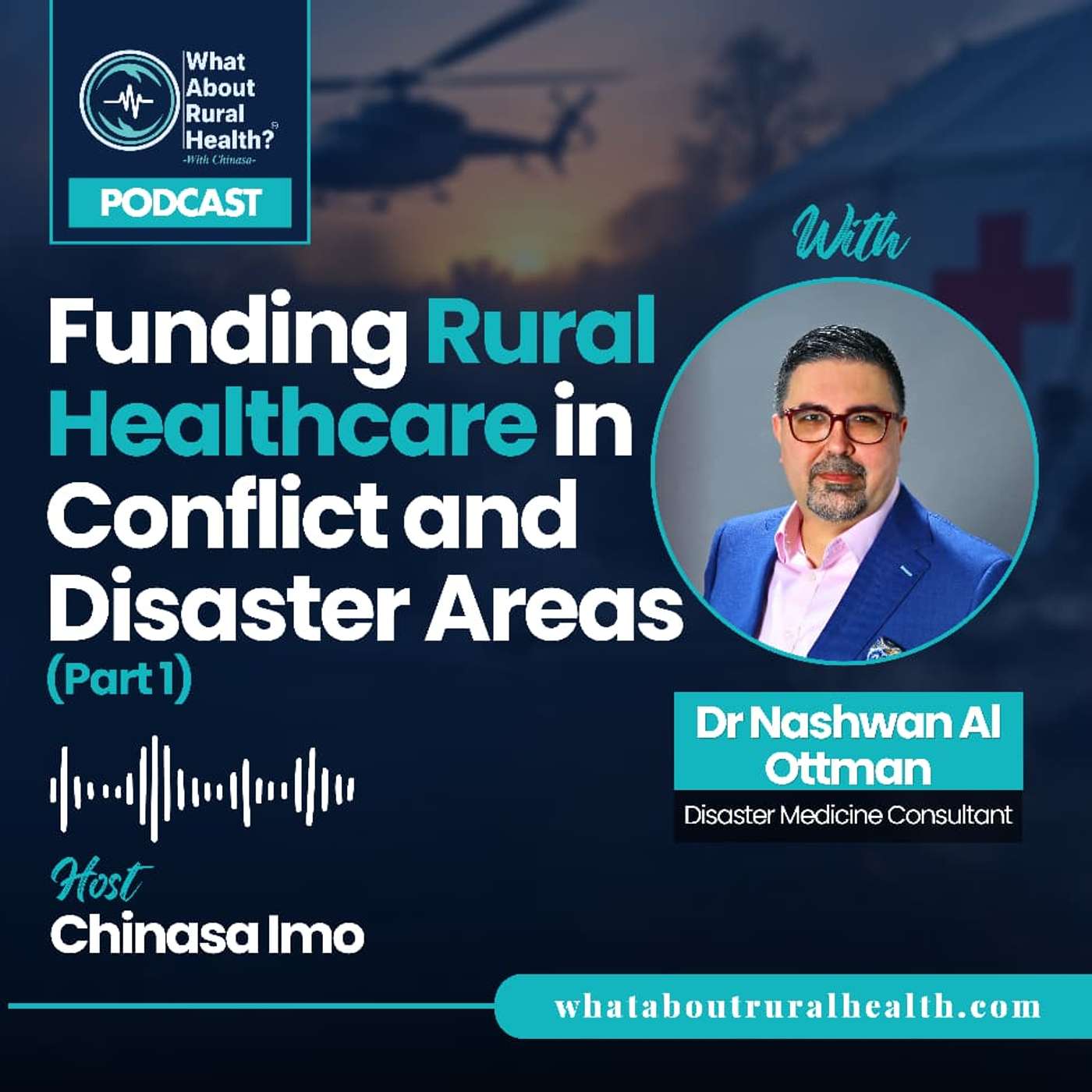
This is the full transcript of the What About Rural Health conversation between host Chinasa Imo and Dr. Nashwan Al Othman on rural health financing in conflict zones and disaster areas. They cover why conflict breaks health financing, the informal care systems that fill the gap, how diaspora funding kept Syrian clinics running, where humanitarian aid falls short, and why community health workers are the best investment a health system can make.
The episode aired in two parts. Listen to Part 1 and Part 2.
About the Guest and Host
Guest: Dr. Nashwan Al Othman
Syrian endocrinologist; disaster medicine and global health in conflict areas
Dr. Nashwan Al Othman is a Syrian endocrinologist and an immigrant now living in Illinois, with a background in disaster medicine and global health, especially in areas of conflict. His work centers on making sure a person's health is not decided by where they live. On the show, Chinasa Imo noted his role in Syria's health system before the war, during it and since, and his part in an advocacy collaborative that lobbies for global health funding mechanisms such as the Global Fund and Gavi. CBS News Chicago reported in 2019 that he left Syria in 2016 after his clinic was bombed. In this episode he speaks for the first time on the show as a project manager and policymaker rather than as a clinician.
Host: Chinasa Imo
Host, What About Rural Health
Chinasa Imo is the host of What About Rural Health, a podcast uncovering the stories, challenges and innovations shaping healthcare in overlooked communities, asking how money moves, who gets funded, who gets served, and who gets excluded.
In This Episode
- 0:00 Opening
- 0:43 Welcome and Episode Overview
- 3:33 Meet Dr. Nashwan Al Othman
- 7:06 Why Conflict Changes Health Financing
- 13:11 Informal Health Systems and Community Resilience
- 16:01 Syria, Sudan, Yemen and Common Financing Failures
- 20:49 Natural Resources, Priorities and Resource Management
- 24:56 Displacement, Cross Border Care and Diaspora Funding
- 29:50 Humanitarian Aid and the Continuity of Care Gap
- 35:58 Global Health Funds and Last Mile Delivery
- 42:24 Donor Conditions, Bureaucracy and Local Priorities
- 47:30 Domestic Priorities and Global Health Security
- 53:32 From Reactive Aid to Resilient Rural Health Financing
- 59:08 Why Community Health Workers Are the Best Investment
- 1:01:48 Key Takeaways and Closing
Opening (0:00)
Chinasa Imo: Humanitarian aid would always have its place. But if crises are becoming recurrent, then our financing model must also evolve, right? Rural health financing needs sustained investment, stronger preparedness structures and innovative financing approaches, because at the end of the day, whether it is conflict or climate shock or displacement, the communities most affected are the ones that are already identified as underserved. So if we are serious about health equity and global health security, then we must make rural health financing more intentional and predictable.
Welcome and Episode Overview (0:43)
Chinasa Imo: Hello and welcome. This is Rethinking Rural Health Financing. You are listening to the podcast that asks the question too many people forget: what about rural health? I am your host, Chinasa, and together we are uncovering the stories, the challenges and the innovations that are shaping healthcare in overlooked communities. In this series, we ask hard questions about how money moves, who gets funding, who gets served, and who gets excluded. From policy to practice, we explore what healthcare financing should look like for everyone.
When we talk about rural health in conflict or disaster areas, we don't just mean communities that are geographically isolated due to constant war or environmental crisis. We are talking about places where infrastructure has totally broken down, governments have become fragile and almost non-existent, and people are constantly on the move trying to find safety. Globally, more than 2 billion people are now living in fragile and conflict-affected settings, and many of them are in rural areas or displaced people's camps where access to health care was already limited even before the crisis began.
What we typically see with health financing in these situations is that funding quickly shifts from routine care towards emergency response. Things like mobile clinics, temporary services or on-the-move care, as communities themselves move, become the feasible form of care delivery. Those are important, no doubt. But the reality is that, going by recent global trends, crises are no longer one-off events. Whether it is conflict or climate shocks or recurring disasters, instability is becoming part of everyday life for many rural communities. If disruption is no longer the exception but increasingly becoming the norm, how do we then finance rural health care systems to survive, or even remain functional, through this reality?
Meet Dr. Nashwan Al Othman (3:33)
Chinasa Imo: That is what my guest and I will unpack today. So welcome, Dr. Nashwan Al Othman, to What About Rural Health.
Dr. Nashwan Al Othman: Good morning, Chinasa. I'm glad to be with you today.
Chinasa Imo: Thank you so much, Dr. Nash. It's such a beautiful and sunny day, so I'm really glad that we are having this conversation during a time when the weather is vibrant and lovely. So Dr. Nash, can you kindly introduce yourself to our guests so that they know who I'm in the studio with? What motivated you to do the kind of work that you do, where you come from, and the things that drive your passion every day?
Dr. Nashwan Al Othman: Thank you, Chinasa, for giving me this opportunity to speak about rural health, and for the first time not as a clinician but as one of the project managers or policymakers, which is a totally different hat. My name is Nashwan Al Othman. I'm a Syrian endocrinologist, an immigrant. I live now in Illinois, in the United States. I have a background in disaster medicine and global health, especially in areas of conflict. I focus more on making sure that your health is not decided by where you live. It means as a human being you have the same right to access health services regardless of where you live, regardless of the country, regardless of the nationality, regardless of the gender or the religion or any different background. That's why I was always passionate about how we make sure that health services will reach every human being everywhere.
Chinasa Imo: Thank you so much, Nash, for introducing yourself. Such a beautiful resume that you have out there. I want to say that I'm really grateful to have you here, especially reading your bio before you joined the podcast, and seeing the enormous work that you do and the role that you continue to play in the Syrian healthcare system, from before the war even started, and the support that you continue to provide during the war and even as we move to post-war Syria. So thank you. I really appreciate you for being here.
Why Conflict Changes Health Financing (7:06)
Chinasa Imo: So, Dr. Nash, let's dive in. When we talk about health financing, or about financing rural healthcare in conflict or disaster settings, what makes this context fundamentally different from, say, a stable environment like where you and I live here in Illinois? I mean, that is also still an issue when we broadly talk about health financing in a stable environment. But I think it's different for conflict and disaster environments. So what is the difference, or what is the shift, in terms of health financing for these kinds of places?
Dr. Nashwan Al Othman: Okay, Chinasa, if I want to give you the short answer, it would be everything. Okay? But let's dive more into that. As you know, in a stable environment, health financing works within a functioning ecosystem.
Chinasa Imo: That's true.
Dr. Nashwan Al Othman: Governments are going to collect taxes and allocate budgets, suppliers will deliver medicines, and health workers will show up for work every day. Okay? So you have a certain predictability. However, in conflict or in disaster settings, that entire ecosystem will collapse, and unfortunately, it will collapse simultaneously. So everything will collapse together. From my experience in Syria, what strikes you first is not just the destruction of the facilities. It's also the collapse of the financial logic, because that financial logic is what keeps the health system alive. You know, suppliers will not deliver to an active conflict zone. Insurance systems become meaningless when people have lost nearly everything and they are constantly moving. The formal banking infrastructure that moves money from donors to providers breaks down and becomes inaccessible.
But the most important thing you can see in such a scenario, and this is always underappreciated, is the trust issue. You know, in a stable setting, health financing depends on institutional trust. Patients trust the system, workers trust that they will get paid, suppliers trust that they will be reimbursed for the goods they delivered. When conflict happens, everything will be destroyed, but first it's the trust system. So even when the money is available, it often can't be moved efficiently, because the human and institutional relationships that channel it are no longer functioning. And when you think about it, those rural areas are always the last to receive any funding in stable times. So you can imagine how bad the situation would be when a crisis hits.
Chinasa Imo: So I want to add a follow-on question based on what you have explained, and I really resonate with what you explained, because I was part of the larger Ebola outbreak in West Africa that happened between 2014 and 2016. It wasn't conflict, but it was a health crisis, and all of these systems broke down simultaneously, which is why we saw a humanitarian crisis emanating from the health crisis, because things were not functioning. And I think that if we draw that into the current Ebola outbreak in the eastern part of Africa, you would still see the same. So the story is quite relatable and translatable across places where these things happen. But my question is, from your experience, when crises begin to happen, do we see an informal health system begin to emerge to fill these gaps that you mentioned earlier on?
Dr. Nashwan Al Othman: Yeah, that's true. And you will see the breakdown happening in phases, actually. The first thing you will notice, usually, and not only in Syria, I think this is going to be something common in all conflict and disaster settings, is that health workers, or most of them, are going to flee. Not because they want to do that, but because they also have families to protect. So suddenly a rural clinic that needs five doctors but only has three suddenly has zero doctors.
The second thing you will see is the supply chain collapse. Medicine shipments will stop. Distributors will not risk sending trucks into conflict zones, and what little stock exists will get consumed within weeks. The next thing you will see is funding flow problems, because government will not pay wages and salaries for people in contested areas. Health workers who stay maybe haven't been paid in months, sometimes even years, but keep working out of duty, out of desperation. International donors start redirecting money toward emergency responses, which sounds logical, but also means other health care needs, like maternal health, chronic disease management and childhood vaccinations, all disappear from the funding conversation.
Informal Health Systems and Community Resilience (13:11)
Dr. Nashwan Al Othman: Because of all those factors, you will see informal systems emerge. For example, community pharmacists will become the de facto primary care providers. Traditional healers will become more popular. Sometimes families pool resources. Local mosques and local churches begin providing medicine. These informal systems are actually remarkably resilient, and nobody is against them. But they are also unregulated.
Chinasa Imo: Yeah.
Dr. Nashwan Al Othman: Uncoordinated. And the most important thing, unsustainable. So they may fill the gap, but they will also introduce new risks.
Chinasa Imo: Yeah. I like the way that you put that in perspective, because I started writing this book, and even in non-humanitarian environments where the health system is very fragile, like where I come from in Nigeria, this set of people that you talked about are the people that communities rally around to bridge the gap that healthcare is currently not filling, right? But that's always the challenge. And when we hear health workers complain, and government complain about people, we're saying, can you take a mirror and look at yourself? And this is in a structure where there is no humanitarian crisis. So this is me, I mean, thinking out loud from what you just said. What that means is that inherently, communities and humans have fundamental systems that they trust, that they know are very resilient, that are going to be available whether in a routine, conflict or emergency period. They're going to be available, while the other ones come and go, a little bit here and there. I mean, it's telling of broadly what the gap is, that the health system as we currently have it is not yet fulfilling, or is not closing, or is not recognizing as a structure that is very important for healthcare delivery.
But what I want to ask you, based on your experience, cutting across places like Sudan, where we have this enormous human crisis right now and conflict everywhere, Yemen, and then Ukraine with the war in Ukraine, and other places: when these countries face this high level of instability, what is the common experience that hits their financial vulnerability, to the point where this system breakdown begins to tell on the people within that environment?
Enjoying this conversation? Hear the full episode with Dr. Nashwan Al Othman on your favorite podcast platform.
Syria, Sudan, Yemen and Common Financing Failures (16:01)
Dr. Nashwan Al Othman: Okay. So, Chinasa, you mentioned Sudan, Yemen and Ukraine, and all three countries have something in common, which is the conflict. However, some of them also have climate-related issues, famine. And if I add one more example, like Venezuela, which was hit by a natural disaster and earthquake recently, you will see that despite very different political and cultural contexts, there's always a predictable pattern. I will focus on highlighting only a few of the common things. This is a longer conversation that maybe needs a separate episode of your broadcast, but I will focus on the most important common things between those impacted communities.
First of all, you're going to see an over-centralization of health financing. Most health systems are designed to funnel money through central government structures. The moment central authority weakens, and it almost always does in conflict, the entire financing architecture will collapse, because there is no local fallback mechanism. Rural areas, because they are already at the end of that chain, will be the first to be cut off.
The second thing you're always going to see is currency and economic instability. For example, in Syria, Sudan and Yemen, hyperinflation and currency collapse meant that even when money was available, its purchasing power evaporated. So a rural health facility may receive a budget allocation that was enough when approved, but it became worthless by the time it arrived.
And the third thing, and this is in my opinion the most important one that we can work on, is donor fragmentation. You end up with dozens of international actors, like UN agencies, NGOs and bilateral donors, each with their own funding cycles, reporting requirements and geographical preferences. This creates enormous inefficiency and leaves some rural areas completely uncovered while others receive overlapping support. Nobody is coordinating the full picture. So this fragmentation always makes people feel, they always say, it's not fair, because we have nothing and the city next to us has everything. So they also start losing trust in the system.
Chinasa Imo: One thing, when you were mentioning these countries, I know I started with three and you added one. But one thing that caught my attention is that these countries have abundant resources, either mineral resources or natural resources. Venezuela, for instance, is a country that sits on top of the world's oil, right? When you look at Sudan, with its natural resources also, and every other place. I know that this conversation is about financing rural health, right? So money is a big chunk of how we are thinking through the questions that we are asking. I mean, this is not a question for you to answer. It could be a question for my audience to grapple with. If these countries are known to sit on top of natural resources, what role does that play in terms of financial architecture during emergencies? Yes, we know the banking system will collapse due to the structures that we have all set in. But I have seen that crisis has never stopped the movement of goods and services. I will go back to my service in Sierra Leone. While we were hit by all of that Ebola crisis, and people were locked down or whatnot, cargo trains were moving every day. It didn't stop. That means that the countries in some ways are generating resources from their natural resources. How do we factor that in terms of intervention, health intervention, during crisis?
Natural Resources, Priorities and Resource Management (20:49)
Dr. Nashwan Al Othman: I think the answer is the same whether we are talking about a crisis area in one of the countries we mentioned or even here in the United States. It's about what you put as your first priority. You see, even here in the United States, sometimes you find that the government will spend billions of dollars on things that most people think are nonsense, while they don't want to cover the meals, the lunch meal for children at school. So the money is always available, but it depends what you think is the most important place to spend that money. It's never about resources. You will always see that how you manage those resources, that's what makes the difference.
I know we are talking about health issues mainly, but I will give you an example. Many people don't know that a country like Sudan has cattle, like cows, sheep, all those animals, in the millions. Their resources in this field specifically are larger than the human population of a smaller country in Europe like the Netherlands.
Chinasa Imo: Wow.
Dr. Nashwan Al Othman: However, the Netherlands is exporting butter and milk and all those things to nearly half of the earth. However, Sudan has a famine and people can hardly find food. So it's never about resources. It's about how you manage them.
Chinasa Imo: Yeah, you just hit the nail on the head, because it's about resource management, and really not about whether the resources are available or whether it's an emergency or non-emergency situation. When countries prioritize how to manage domestic funding, how to appropriate it and the medium by which they appropriate it, it makes it easy for such countries to buffer up during emergencies. So what I want to ask is a little bit around that management, because war, crisis, even climate issues cause people to migrate. They cause displacement, and people moving to different places. So I'm wondering, in places where these things are happening and people are moving across, it means care is no longer situated in one place. A typical clinic will not serve the original people who lived in those communities when those clinics were built, because those communities might have migrated out of conflict or climate issues and they are on the move. In situations like this, do we have cross-border coordination that provides portable health or flexible health insurance, or even diaspora funding, that plays an important role in addressing rural health issues in this kind of movement?
Dr. Nashwan Al Othman: Yeah, sure. Actually, this is one of the most complex challenges. In traditional health financing systems, you make the assumption that you have a defined, stable population. You know, government will register people and track them, and based on the population you have in a certain area, you plan services, you allocate budgets. But when that population is moving, sometimes on a daily or weekly basis, the entire model will not work anymore.
Chinasa Imo: Yes.
Displacement, Cross Border Care and Diaspora Funding (24:56)
Dr. Nashwan Al Othman: So from what I have seen, a few mechanisms show real promise, despite none of them being 100% perfect. For example, what you mentioned, cross-border coordination, is critical but unfortunately deeply political. You know, in the Syrian context, the Turkish, Jordanian and Lebanese borders became important health corridors, but coordination between health systems was minimal. You see that people cross the borders sick and receive no continuity of care, because their health history didn't cross with them. So you don't have any background about their medical history, what medication they were taking, what previous care they received.
In some situations, portable health records, particularly digital ones, are very transformative, but the implementation is not always easy, because sometimes in conflict zones there's an issue regarding electricity, connectivity or the availability of the devices themselves. We saw some cases of paper-based patient cards, but they are far from being a functional system.
You mentioned diaspora funding, and this is actually one of the most underappreciated and underutilized resources. In the Syrian case, Syrian diaspora communities around the world, like in Europe, in the United States and in the Gulf countries, sent support and funded specific clinics and hospitals back home. This was informal, sometimes uncoordinated, but it was very, very impactful. Many people are still alive today because of these efforts of the diaspora. But it was kind of a learning curve. So from things that we were doing, for example, in 2011 and 2012, we learned from that practice and we applied some improvements. We started with some uncoordinated efforts, but we got more formalized, and with that improvement, most of the Syrian stakeholders in this field managed to unlock significant resources and bring them directly to the communities. And of course, there are multiple examples in other countries. Syria is not an isolated case.
We also saw some flexible insurance models, and this is not related to formal insurance companies, because as you know, formal insurance logic will not function in active conflict zones. But we saw, for example, in displacement camp settings, some community health funds and prepayment models that have shown some success. And those community funds were not only designated for health needs. Sometimes it was if they wanted to buy new clothes for the kids, or if they wanted to buy some food because the month of Ramadan was coming. So people in those displacement camps learned how to establish those flexible models. In some places they were efficient and in other places they were not, but it was there.
Chinasa Imo: Okay. So this helps me bring in the other aspect of funding models that we often talk about a lot, and I think you've mentioned it here as well, and that is humanitarian money, right? Humanitarian aid. Because whenever crisis happens, there is always this influx of humanitarian aid, from governments and their agencies, from ODA money, from foundations. Someone calls that [unclear] pockets.
Humanitarian Aid and the Continuity of Care Gap (29:50)
Chinasa Imo: And I would not diminish the importance or the critical support that this funding plays, because I've seen how that money actually bridges the gaps and helps solve problems, like the supply of vaccines, the supply of life-saving equipment, et cetera. So this question is not about diminishing what humanitarian aid does. It supports affected countries to respond to these events. However, let's talk about the elephant in the room, which is that aid is not designed for long-term system building, right? It comes, it solves the problem, and it exits when it feels like the emergency has diminished to a manageable point. So from what you have seen on the ground, where do the biggest gaps show up when it comes to financing rural health specifically, both during the emergency and immediately after the emergency crisis phase has passed?
Dr. Nashwan Al Othman: Chinasa, you know what the Americans say, that somebody got their 15 minutes of fame. Emergencies and crises also sometimes get their 15 minutes of fame, and that's it. Everyone will forget them after that.
If I want to talk about the biggest financing gaps, in my opinion the biggest gap you will see is the continuity of care for non-emergency conditions. Okay? When humanitarian funding floods in, usually it focuses on trauma care, infectious disease control and reproductive emergencies, and that's vital for sure. But people, for example, with diabetes, with hypertension, mental health conditions, cancer, they essentially fall off the map. And when you think about it, rural areas already have limited infrastructure when it comes to, for example, specialist capacity or equipment related to these areas of care. So that's why they are hit hardest, because they already started behind when it comes to this area.
Also, you will see that the post-crisis gap is even more devastating, because it's less visible. Once the acute emergency phase passes, donor attention will move on, and most importantly, media will move on. But the rural community is left with a health system that is partially destroyed, health workers who are traumatized and haven't been paid in maybe months or years, and a population with enormous accumulated health needs. Okay? Sometimes people need a surgery, but it's not an urgent surgery, so they didn't do it now. But this does not mean that they don't need to do it next month or next year. So you have those accumulated health needs.
The transition from humanitarian response to development financing is always slow and poorly coordinated. And I have seen communities in other countries, and to be honest with you, I'm afraid that some communities in Syria will be the same, where that transition never really happened. They remained in a permanent humanitarian dependency for years. So the transition is always slow, but it's not even guaranteed that it will be complete.
There's also a critical gap around mental health financing, because the psychological toll of conflict on rural communities, whether we are talking about PTSD, depression or grief, is enormous, but it receives a fraction of the funding that physical health receives. And you know, without addressing mental health, communities can't effectively [rebuild].
Chinasa Imo: I love the way that you put this, because you captured literally everything that was coming to my mind when I was asking that question. But I want to turn to our listeners, especially those that are in policy or that are doing global health financing work. I've been reflecting on this for a while: when countries invest in global health funds, are they thinking only about diplomacy and development, or also about rural health security and emergency preparedness? I want to hear your thoughts, because this conversation is broader than just rural health in emergencies. We're trying to explore what it means when funding steps in as part of the response, and what that intention means.
Global Health Funds and Last Mile Delivery (35:58)
Chinasa Imo: So, Nash, I'm back to you. I want us to stay a little bit more on this global financing dimension, because we cannot discuss rural health, or health generally, within conflict or emergency contexts without acknowledging the role of global funding pools in responding to the health crises that such events produce. And I know that you are part of an advocacy collaborative that engages in lobbying for funding mechanisms like the Global Fund for AIDS, Tuberculosis and Malaria, child immunization initiatives like Gavi, and other broader global health financing conversations. And of course there's always this tension between national priorities, like the US, you know, America First, that we have with this current administration, and the posture that this presents in global health financing, but also the realities of what that means for global health interdependency. So I am curious what you think about how all of this plays out, specifically with rural health financing in fragile and conflict settings.
Dr. Nashwan Al Othman: This will really depend on the implementation. You know, rural communities in conflict settings are often the last to benefit, even when the funding exists. The Global Fund and Gavi are very critical in weak settings. They have maintained HIV treatment programs, malaria prevention and childhood immunization coverage that governments simply can't finance themselves. Without them, mortality rates would be significantly higher. And I want to be clear about that: these mechanisms save lives. They have been saving lives not only for a year or two. Some of those programs have been saving lives for decades. But the bottlenecks are real. We will not hide behind our fingers.
One is last-mile delivery. A grant can be perfectly designed at a global level, disbursed to a national ministry, flow through a regional health directorate or authority, and then stop entirely when it hits the conflict-affected rural district. The accountability and reporting structures that these funds require are designed for a functioning bureaucracy. However, in a rural health facility, you will find that the administrators are often dealing with physical insecurity, staff shortages and destroyed infrastructure. They can't meet the complex donor reporting requirements.
Chinasa Imo: Yeah.
Dr. Nashwan Al Othman: So they drop off the list. And sometimes you will see a situation where those communities are not receiving funding, not because the donor does not want to deal with them. They actually stop applying for funding because they don't want to deal with such a demanding donor. And I saw this in multiple cases, in communities and organizations, whether in Syria or other countries: okay, we need this money, but this money is coming with a lot of headaches and hassles, and we don't have time for this. Yeah, it's not like, okay, this donor has a blacklist of NGOs that it will not deal with. No, you will find that NGOs also develop a blacklist of donors.
Chinasa Imo: I absolutely agree with you. In fact, I own a nonprofit back in Nigeria where I have young people run the nonprofit and support, create safe spaces for engagement at the state level with policies, community development, youth development and so on. We had a consultant come to review us, to see our organizational healthiness, and I was sitting in the meeting and this person kept asking questions. At some point I'm like, hey, we care in our organization. I understand that money is stifling and we haven't received that much donor funding. But part of the reason is that if we deprioritize the contending issues that we address at the local level and start looking at every whim and caprice of what a donor wants, we will spend time producing protocols and guidelines and documents and the automations that don't help us in any way, that don't have any particular impact in the lives of those we set up the organization for, or write our goals and objectives and say this is what we are going to do. So please, is this process necessary? If that's what the donor wants, well, the donor can keep their money, and we can figure out a way to continue to work with the communities to provide help.
Because I would rather that we use our staff strength and capacity to deal with an issue that is reported to us. Say we have a domestic violence case, right? We're not going to go with a donor checklist and start checklisting rather than responding first. Sometimes we can't do both, and that is what most of these NGOs are navigating. We have real issues in our face, but they don't want us to do A, B, C, D, all the way to Z. It's like US insurance: you come to a hospital, and they want to know the kind of insurance you have before they ask you what your problem is. We are unable to do that, because the problem is facing us. So I'm glad you raised that issue.
Donor Conditions, Bureaucracy and Local Priorities (42:24)
Chinasa Imo: But if we take it up a notch, to talk about most national governments and the conditionalities, especially of ODA funds. Donors like foundations, et cetera, are sometimes even far more flexible than governments, because many of them also have objectives that are in alignment with local nonprofits and interventionists. But most governments come with different asks that kind of make it difficult. Can you say a little bit more about that?
Dr. Nashwan Al Othman: Yeah, I will explain that, but let me just mention something that sometimes you can look at as an advantage, but sometimes it's a disadvantage. Most of the programs you were talking about are disease-specific. Okay? And because they are disease-specific, they also bring another set of requirements that they need you to follow. So for example, you may have a well-funded malaria program operating out of a building with no running water, no surgical capacity or no maternal care. So that's also one of the things we need to deal with. When it comes to governments, they always have a political logic behind it. Okay? So you always need to try to make the balance between what they are asking for and what you need.
I will give you an example, and some people find this example funny, some people find it sad. About a year ago, I was in a conversation with a staff member from a very important donor, and it happens that the donor is actually a government. He had his concerns that a training location in one of the small villages in Syria, on the borders of the desert, had no ramp for people who are using wheelchairs.
Chinasa Imo: Mm-hmm.
Dr. Nashwan Al Othman: Okay. Which is important, but in that scenario, none of the attendees needed a wheelchair, and the village that I'm talking about has no electricity, no water supply. I don't even understand why people are still living there. Okay?
Chinasa Imo: And he's concerned with a ramp.
Dr. Nashwan Al Othman: Yeah. And we wanted to train some local healthcare staff just to do the triage, so we would save people from going to the main hospitals in the city center if there is no need to do that. So what we were doing was just training local healthcare workers to do the triage, like, you need to go to the hospital or not. And we were utilizing telemedicine, so those local health workers would report to doctors, most of them outside the United States: okay, this is what we found. And they report the results to the patient. So he was concerned about having the ramp, and at that time I was nearly fed up with that conversation. So I told him, "Okay, fine. When you visit our country, go to your country's embassy in Damascus, in the capital, and tell me if you have a ramp there."
Chinasa Imo: Oh, wow.
Dr. Nashwan Al Othman: Because I have been in that embassy before, and I'm pretty sure they don't have a ramp.
Chinasa Imo: Mm-hmm.
Dr. Nashwan Al Othman: He was following a certain checklist, and he was very bureaucratic about it. In reality, it would not cost me that much to make a ramp for him there, but that ramp will not solve the issues that they have in those communities.
Chinasa Imo: I agree with you, and I think those are things that we need to chew on critically: how we push our checklists and conditions, especially when we're doing cross-border support, and what that means. Because if those checklists are not local priorities, it means you are not sensitive to the environment you want to support, and to the priorities of what they actually need versus what you think they need. And that's a big concern in development work, in program design and intervention, especially for rural health.
Domestic Priorities and Global Health Security (47:30)
Chinasa Imo: I want to pivot a little bit, to bring back the argument around domestic funding priorities. So we've talked about local domestic issues and the funding vulnerabilities, and now we've talked about global humanitarian aid and national bilateral funding that flows into other countries. But how do we reconcile the inward focus with the global health security reality that instability elsewhere, whether conflict, outbreak or disaster, eventually affects everyone? And bearing that in mind, how do we now use policies to strike a balance between improving both aspects of the funding mechanism?
Dr. Nashwan Al Othman: Of course, I understand the political logic behind making domestic needs a priority, and of course any elected government has a responsibility to its own citizens. However, when it comes to thinking about America First, I think there is a lot of framing of these global health needs as a false choice. For example, if we go back to those bad days of the COVID-19 pandemic, you know, the virus didn't respect borders or foreign policy positions. When you see conflict-driven outbreaks, like for example cholera in Yemen or Ebola in the DRC, those diseases will not respect the borders. They don't need passports or visas to enter any country in Europe or even North America.
And if we want to talk from a national security and economic standpoint, investing in global health readiness, including rural health in conflict zones, is far cheaper than responding to the pandemics and displacement crises those problems will generate. You know, the United States spent trillions of dollars responding to COVID, while the annual US contribution, before the cuts made by the current administration, was like a fraction of 1% of that. You don't need to look at global health spending as charity. And this is what we always argue to policymakers: reframe the conversation. This is not charity. This is a global health security investment.
Chinasa Imo: Yes.
Dr. Nashwan Al Othman: When those rural health systems in less functional states collapse, the consequences, like migration, disease spread, instability and terrorism, will eventually arrive at your borders.
Chinasa Imo: Yeah.
Dr. Nashwan Al Othman: So to be ready is always cheaper than what you need to respond.
Chinasa Imo: I want to rephrase what you have just said for my listeners, just in case they missed it, especially for those who hold decision-making power. Disease outbreaks, displacement and instability rarely stay confined geographically. So as countries think about national health priorities, it is important they also consider the implications for cross-border public health relations.
So, let's talk finance, the rural health financing model. Now, if we accept that crises are increasingly becoming recurring realities, right, whether it is conflict or climate shock or natural disasters, they often lead to prolonged instability. And we have established the fact that rural access to healthcare collapses, and sometimes countries become severely dependent on donors. What that should then mean is that emergency preparedness financing for rural health should be something that we take up as an important financing architecture, right? And some system design thinking that assumes disruption as part of the new global ecosystem would make an argument that we should build for those kinds of eventualities. So, Nash?
Dr. Nashwan Al Othman: If we look at the current situation, the current model right now, you will see that global health financing will largely activate when a crisis hits.
Chinasa Imo: Mm-hmm.
Dr. Nashwan Al Othman: Money will start to flow in, emergency response happens, and then it withdraws.
From Reactive Aid to Resilient Rural Health Financing (53:32)
Dr. Nashwan Al Othman: And we need to invert this logic. We need to move from being reactive to being resilience-based. And when I say resilience-based, I mean that we need to invest in rural health infrastructure before the crisis, in ways specifically designed to withstand the disruption that usually happens with the crisis, as we talked about earlier today. So for example, we can have prepositioned funding mechanisms, like having stashes of resources. Because, as you know, when you have a crisis reserve at the regional or national level, you can start moving these funds or resources within days.
Chinasa Imo: Yeah.
Dr. Nashwan Al Othman: But if you don't have it, and you need to wait for the international response, you're going to need months to have this happen. The current system, from my experience, takes between 6 and 12 months to mobilize significant resources after a crisis is declared. That's 6 to 12 months of people dying from preventable causes. Whereas if you have these prepositioned funds or resources at the regional or national level, you can start moving those resources or funds within days.
Also, you need to create a kind of modular, decentralized health infrastructure, like facilities and supply systems that are designed to function without central grid electricity, without continuous supply chain access, without stable communication networks. For example, you can have solar power, you can have restocked emergency medicine caches, you can train community health workers who can function independently. These are not expensive innovations, but they are very practical design choices.
The most important thing that we can advocate for when we are having conversations with decision makers is also to have flexible multi-year funding rather than annual grants with rigid spending categories. Sometimes in a rural health system setting, you need to have the ability and the flexibility to make some adaptive management choices that allow you to do some reallocation in certain circumstances. We have an internal joke about that: when the donor authorizes spending to buy pencils, you can't buy pens. Okay? Which is not making any sense. But you need to give those project managers at the local level some flexibility to manage the daily changes. Okay? And of course you can put limitations on that flexibility, but you need to give them some flexibility.
Chinasa Imo: Yes, I love the way that you put this. And one thing that I would say I'm taking away from this, because there's always this argument, or debate, about where this money should sit. Do we channel more resources directly to local actors who understand the terrain, or should we strengthen centralized systems for coordination and accountability? I think it's obvious that we've done the latter for so long, and we recognize that it collapses and it doesn't function, especially when the functional systems and assumptions they were built on collapse. So that brings us to really think about how we make sure that local actors who understand this terrain are empowered enough to do their work, because they are the people who will still be there when crisis hits.
So Nash, as we wrap up, this is my final question, and I like to come to this conversation with a forward-looking agenda. We can discuss the problems, but we have to have something that we look forward to at the end of the day. So if you were to recommend one financing priority to make rural health systems more resilient in a stable setting, now, this is not in an emergency setting but in a stable setting, what would it be? What key lessons from Syria should policymakers keep in mind when they are designing for their own stable systems?
Dr. Nashwan Al Othman: So what I'm going to say, Chinasa, actually applies to the health sector, but you can apply it to any sector you may think about. Okay?
Why Community Health Workers Are the Best Investment (59:08)
Dr. Nashwan Al Othman: My single financing priority would be investing in community health worker networks as permanent, funded infrastructure. Not project-based, not volunteer-based, but professional, paid, trained and equipped assets of the community. Those community health workers are the most cost-effective intervention in global health. They are the bridge between us and the local communities. You know, if I had a dollar for every time an international NGO made an assumption about a certain need of the community and ended up wrong, I would be a millionaire.
Yeah, we have dozens of stories about that. Those local health care workers are very critical during disaster, during conflict. They belong to the community, and they usually don't evacuate, and they get displaced with their communities. They know every family, every chronic patient, every pregnant woman in their community. And the most important thing: don't wait for the crisis to build this network. Start before, because, you know, this is one of the lessons I learned from Syria. The communities and health systems that survived best in Syria were the ones where trust had already been established between health workers and communities before the war began. You know, where people know their local health worker by name. They know how good they are. They trust them. So that's why they were more eager to engage with the systems that they are creating. And believe it or not, no amount of money can substitute for those relationships once a crisis hits. So let's invest in them, and let's do that during stable times.
Key Takeaways and Closing (1:01:48)
Chinasa Imo: Dr. Nash, thank you so much. I truly appreciate you sharing your experience and insight with us today. This has been a very meaningful conversation, and I'm glad that we could have it. I would say that, honestly, one thing that really stood out for me from this conversation is that financing rural health in conflict or disaster settings cannot remain reactive. We established very clearly that humanitarian aid would always have its place. But if crises are becoming recurrent, then our financing model must also evolve, right? Rural health financing needs sustained investment, stronger preparedness structures and innovative financing approaches, because at the end of the day, whether it is conflict or climate shock or displacement, the communities most affected are the ones that are already identified as underserved. So if we are serious about health equity and global health security, then we must make rural health financing more intentional and predictable.
To everyone listening, thank you for joining us on today's episode of What About Rural Health. If today's episode moved you, or challenged you, or made you think a little bit differently, please follow, subscribe, and leave us a review on your favorite podcast platform. And as always, I'll keep asking the question: what about rural health? Until next time, I am still your host, Chinasa. Bye for now.
Want more conversations like this one? Subscribe to the What About Rural Health newsletter for new episodes, articles, and rural health financing insights.
Editor’s note: The views in this conversation are the guest’s own and do not necessarily reflect those of What About Rural Health. This transcript is for information only. It is not medical advice. Please talk to a qualified health professional about your own care.