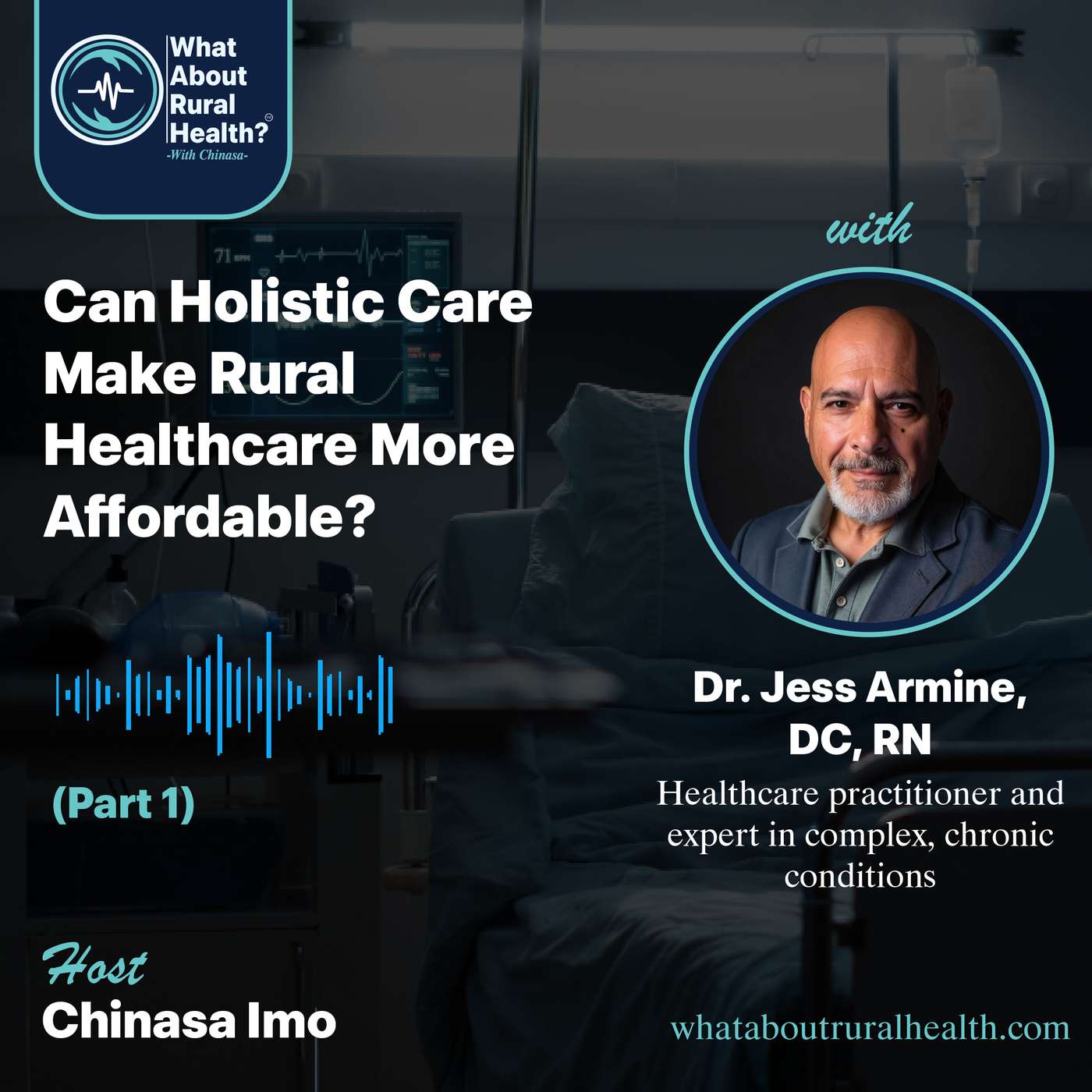
This is the full transcript of the What About Rural Health conversation between host Chinasa Imo and Dr. Jess Armine, a functional medicine practitioner with 50 years in healthcare, on whether holistic care can make rural healthcare more affordable. They cover how medicine lost the generalist, why patients turn to online searches, how payment and reimbursement shape care, and how telehealth and integrated clinics could work in rural areas.
The episode aired in two parts. Listen to Part 1 and Part 2.
About the Guest and Host
Guest: Dr. Jess Armine
Functional Medicine Practitioner & Neuroendoimmunology Specialist
Dr. Jess Armine has spent 50 years in healthcare, starting in 1975 as an EMT and one of the first paramedics in New York City. He earned a bachelor's degree in nursing in 1978, served as an Army nurse, and later became head nurse of a coronary intensive care unit. He trained as a chiropractor, graduating in 1986, and went on to specialize in neuroendoimmunology and functional and integrative medicine. He now runs an entirely virtual, worldwide practice treating complex, multifactorial illnesses that haven't resolved through conventional care, and teaches functional medicine courses to other clinicians.
Host: Chinasa Imo
Host, What About Rural Health
Chinasa Imo is the host of What About Rural Health, a podcast uncovering the stories, challenges, and innovations shaping healthcare in overlooked communities, asking how money moves, who gets funded, who gets served, and who gets excluded.
In This Episode
- Cold Open
- 0:52 Introduction
- 1:44 A Rural Patient's Story
- 4:02 The Over-Dependence on Testing
- 5:08 The Cellular Root: Spike Protein and Mitochondria
- 16:07 Meet Dr. Jess Armine
- 19:12 Why Human Medicine Got Bifurcated
- 21:38 How Medicine Lost the Generalist
- 26:00 Neurotransmitter Testing and the SSRI Guessing Game
- 29:37 Bringing Back Holistic Care
- 36:20 Holistic Care and Cost Savings
- 38:45 Why Patients Turn to Google
- 42:27 Evolution, Not Revolution
- 45:39 Payment Models and What Drives Care Delivery
- 48:00 The Reimbursement Math
- 50:01 Insurance Economics, MRI Pricing, and Obamacare's Rollback
- 55:23 Rural Implementation: Telehealth and Integrated Clinics
- 1:01:39 Physician Training for Integrated Care
- 1:06:12 Where Policy Change Has to Start
- 1:11:01 Closing Tips: What to Look For in a Practitioner
Cold Open
Dr. Jess Armine: When we talk about health and what generates health, you have to talk about the cell. Remember that when you put cells together, you get tissues. When you put tissues together, you get organs. When you put organs together, you have a body. So instead of treating the thyroid, or the liver, or the pancreas, or the IBS, or whatever it happens to be, you want to look at the dysfunction in the cells.
Introduction (0:52)
Chinasa Imo: Dr. Armine, welcome to today's episode of What About Rural Health, where we ask hard questions about how money moves, who gets funded, and who gets left out. From policy to practice, we explore what rural health financing should look like for everyone.
Dr. Jess Armine: I'm very happy to be here. I appreciate the opportunity to speak with you and your audience.
Chinasa Imo: Today's conversation: can holistic care make rural healthcare more affordable? We'll dive into how integrated care models could provide affordable care and address care fragmentation issues in rural communities, part of our ongoing series on rethinking rural health financing.
A Rural Patient's Story (1:44)
Chinasa Imo: While preparing this episode, I had a conversation with a nurse friend who works in a small rural suburban area in Illinois. She told me about a patient dealing with fatigue, joint pain, and severe brain fog, ongoing since the COVID pandemic. That patient has seen multiple doctors, run several tests, and been prescribed medication that addresses some symptoms individually, but nobody has answered the question of what's actually going on in her body. The bills keep piling up, the travel to the nearest health facility keeps adding up, and she's still searching for relief. This is a common experience.
Dr. Jess Armine: First off, if I heard correctly, the nurse practitioner is one of the best practitioners you can go to. Before I was a physician, I was a nurse. Before that, I was a paramedic. The closest you're going to get to true, general care today is with a nurse practitioner. Modern medicine has become extraordinarily specialized, which has brought advances, but also fragmented care. Somebody with fatigue may see a rheumatologist, then a gastroenterologist, then a neurologist. Each specialist is good in their field, but they don't look at the entire person the way a generalist, or old general practitioners before 1970, used to. We always hope to get back the practitioner who essentially knew your family, and that was valuable.
The Over-Dependence on Testing (4:02)
Dr. Jess Armine: Instead of what Sir William Osler, the founding father of Johns Hopkins, said, listen to your patient, they're telling you the diagnosis, we now look at evidence-based medicine, which means if the test doesn't show it, it doesn't exist. Nobody talks about the limitations of testing. If you sit down and listen to your patient and know the clues, you can start correlating them. Testing is inaccurate in a lot of senses, normal ranges are just part of a bell curve of a hundred thousand tests. If you're in the lower part of the range but having symptoms, maybe that's not normal for you. That's why we call it individualized or personalized medicine, which should be the forefront.
The Cellular Root: Spike Protein and Mitochondria (5:08)
Dr. Jess Armine: The studies coming out, and my particular practice, I'm on the forefront of this, point to COVID, whether from the vaccines or the virus itself, hurting the body through the spike protein. Those particles occupy certain receptors and interfere with critical body functions. Since the pandemic, we've seen an increase in fatigue, fibromyalgia, pulmonary problems, heart problems, cancer, infertility, and anything connected to chronic inflammation, autoimmune diseases, rheumatoid arthritis, Hashimoto's. Why? The spike protein affects mitochondrial function. Your mitochondria is what creates your energy.
Think of energy as a percentage. You're normally running at around 95%; nobody's at 100%. An acute illness like strep throat might drop you to 80% temporarily, then you recover. But as we go through life we pick up chronic conditions that degrade that baseline, say down to 75%. The spike protein can drop mitochondrial function from 75% to 50 or 55%, which is nasty. Somebody who had no problems before gets ill and never gets back to their former energy level. Doctors are now identifying this pattern widely enough to give it a name, spikeopathy, dysfunction that starts at the cellular level and radiates into whatever symptoms a patient eventually notices. That's the thing that almost no one treats.
My practice is entirely virtual and worldwide. I take care of complex, multifactorial illnesses that haven't gotten success elsewhere. My first visit with a patient is two hours, I get a good history, then correlate the testing, then come to a conclusion, or at least a general direction.
Meet Dr. Jess Armine (16:07)
Chinasa Imo: Before we go deeper, I know my audience is wondering who this is. Can you give us a background of who you are?
Dr. Jess Armine: I've been in healthcare in one form or another for 50 years, starting in 1975. I started out as an EMT and became one of the first paramedics in New York City. At the same time I decided to become a nurse, I come from a poor Italian family where almost no one graduated college, so I thought becoming a doctor was beyond me. I got a bachelor's of science in nursing in 1978. I was also in ROTC, so I went into the Army and was an Army nurse for several years, starting in emergency and then becoming head nurse of a coronary intensive care unit.
I decided to become a chiropractor and graduated in 1986, started practicing standard chiropractic, and also started a family. But it felt limited, I love putting the puzzle pieces together. I had an interest in how alternative and traditional medicine interacted. One of my children developed mental illness, a bright, intelligent boy who read Dante's Inferno at ten and explained it to me, and medications turned him into a nonentity. I got very angry, and as a Christian minister, I started praying and looking for answers. I started developing expertise in neurotransmitters and got the first certification in a subspecialty called neuroendoimmunology, the relationship between the immune system, nervous system, and hormone system, since they constantly talk to one another. That's the basis of homeostasis.
Why Human Medicine Got Bifurcated (19:12)
Chinasa Imo: When I think about where we moved from having comprehensive care, where you could trace something to the whole body, to now, where we have fragmentation, it seems like somebody decided different doctors would just focus on different parts of the body. How did we get here?
Dr. Jess Armine: I actually saw that transition happen.
How Medicine Lost the Generalist (21:38)
Dr. Jess Armine: Before we had our GP or family doctor, remember Marcus Welby, M.D.? He was the quintessential family doctor, he knew everybody, knew everything, and would send people to specialists only when necessary. I had my own version: Dr. Siegel, who knew everything, knew me, my parents, my grandparents, the guy who came to your house when you had a 103 fever. When he sent you to a specialist, the specialist would barely talk to you; they'd call your doctor, your doctor would call you back and translate it. You had the comfort of knowing you had an advocate who never steered you wrong.
Then the 1970s happened. I literally watched the shift toward specialties. The GP got ostracized, you had to be a specialist. That's fine, except no one was coordinating. You'd go to an orthopedist, then an internal medicine doctor, then someone treating diabetes, and the system changed so nobody put the puzzle pieces together. If a woman comes in with belly pain, is it gastrointestinal? Gynecological? Genital urinary? Kidney? She'll go to one specialist, then another, making appointments each time, and the onus of diagnosis lands on the person least trained to do it: the patient. Family doctors still exist, but you're lucky to get 15 or 10 minutes, not the doctor's fault. Medicine became corporatized, and corporations want productivity, forcing doctors into models where they see four to six patients an hour. That's part of why physician extenders, PAs, and nurse practitioners came into wider use, and if you get to see a nurse practitioner, you're usually doing pretty good, because they have more time.
🎧 Enjoying this conversation? Hear the full episode with Dr. Jess Armine on your favorite podcast platform.
Neurotransmitter Testing and the SSRI Guessing Game (26:00)
Dr. Jess Armine: This is worse with mental health problems. If you go to your doctor for depression, they'll give you an SSRI, presuming you have a serotonin issue, that's poor judgment. Thirty days later it's not working, so they double the dose; still not working, they try a different one; six months down the road maybe they try something that raises dopamine and norepinephrine instead of serotonin. They're guessing, when there is neurotransmitter testing available. If you look at the pattern, you get an idea of what's up and what's down, and I can usually start better than most people from there.
Bringing Back Holistic Care (29:37)
Chinasa Imo: How do we marry this evidence-based system we've pushed ourselves into, where insurance is the face before even a doctor asks who you are, with bringing back holistic care?
Dr. Jess Armine: Let's use generalized terms rather than buzzwords, holistic, personalized, integrative, functional medicine. Traditional allopathic medicine is very far down its own road; I teach a lot of medical doctors and they're frustrated as heck, because they're caring for people and it's not working. So a different point of view enters: holistic or functional treatment means picking up the whole-person approach the old GP used, bringing all your experience and listening to the whole story. You can approximate that generalist role even today if you spend time learning about a patient, I teach a course on exactly how to take that kind of history. But because everybody now wants a specialist, when I tell someone I'm a doctor, the first question is "what's your specialty?" The alternative medicine world has fallen into the same trap of over-specializing, and it's the patient who suffers either way.
Holistic Care and Cost Savings (36:20)
Chinasa Imo: One argument is that caring for the whole system rather than isolated parts can reduce long-term healthcare costs. From your experience, how can this holistic approach make care more affordable or save costs for rural patients?
Dr. Jess Armine: Care is fragmented and much worse for rural patients. A nurse practitioner or holistic practitioner who takes responsibility for connecting the dots gets you on the right track instead of you wondering whether it's your kidneys, your gallbladder, or just gastritis. That cuts healthcare costs for the patient and the insurance company, because you're not paying for a string of separate specialist visits to rule things out one at a time.
Why Patients Turn to Google (38:45)
Dr. Jess Armine: The onus is sadly on the patient. What do you do? You go to Google, Dr. Google, my absolute nemesis, or WebMD. That's an indication of a gap in the system. When you go to a typical doctor, they'll tell you the worst thing you can do is go ask Google or AI about your symptoms. But the reason people do that is trust, we lost trust in the medical system, and access, it takes a whole lot of effort to book an appointment.
Chinasa Imo: I use myself as an example. Between the time I saw my PCP and when I actually got an appointment with a pain medicine specialist, I'd already asked an AI what I was feeling, because the wait was too long and I was tired of the system.
Dr. Jess Armine: The problem with Google or any search engine is that once you put in a set of symptoms, you then have to fight through pages that are selling a product, that's rampant, and it's not just diagnosis, it's treatment too. I've seen a lot of this coming down the pike, especially in alternative medicine, which isn't under the same advertising constraints as pharmaceutical commercials.
Evolution, Not Revolution (42:27)
Dr. Jess Armine: So what can we do about this? It's not going to be a revolution, it's got to be an evolution. In your rural community, under the traditional medicine system, you need to get in either a good holistic practitioner or a good nurse practitioner who takes on the old general-practitioner role. Nurse practitioners trained in family or pediatric medicine know their stuff, and once you put traditional and non-traditional practitioners together and make it work, you'll see it's less costly and more accessible, and once a model becomes successful, people want to duplicate it.
Payment Models and What Drives Care Delivery (45:39)
Chinasa Imo: There's also the question of care financing, the current payment model creates incentives for how clinicians literally practice, because the reimbursement process dictates what treatments move forward. How do we bring medicine back to a place where patients are comfortable receiving care and providers are happy to deliver it?
Dr. Jess Armine: The system on the diagnosis-and-treatment end is algorithmic, symptoms plus tests lead to a diagnosis, which is tied in the ICD to a pharmaceutical protocol. The insurance company wants evidence, meaning testing. Someone can have subclinical hypothyroidism with all the symptoms, but if it doesn't show up on the test, a practitioner isn't allowed to treat it that way without risking a review, and ultimately their license. Reimbursement is codified by exam level and face-to-face time, and it isn't as generous as people think.
The Reimbursement Math (48:00)
Dr. Jess Armine: When I was a chiropractor, I could charge whatever for a manipulation, but if the insurance company only allows $40, that's what gets reimbursed, I'm not joking, that's exactly what it is. Most alternative medicine practitioners like myself don't take insurance anymore. Using the highest-level billing code for a two-hour visit, insurance reimburses about $85, and that's not counting the hour beforehand and the hour afterward building the treatment plan. I can't live on that. If I'm seeing one person at a time and can't get reimbursed for my time, I can't pay the rent for my office.
Insurance Economics, MRI Pricing, and Obamacare's Rollback (50:01)
Dr. Jess Armine: That has to change, and it's ingrained. The nurse practitioner may edge a little more, but insurance reimbursement isn't going to improve anytime soon, especially since this administration killed Obamacare, and now premiums are going way up while reimbursements go way down. The way insurance companies make money is by charging premiums but not paying claims. They have it down to the minute: a hospital may charge $10 for Tylenol but get reimbursed 50 cents. An MRI used to be a $1,500-$2,000 deal; now insurance pays about $300 for one, which is why you see MRI centers open from 6am to midnight, they need the volume. The reality is people treat with whatever insurance they have, and I don't blame them, but that limits who you can see. In far rural places it's worse: you might have insurance but it can take four hours to get to any kind of care.
Rural Implementation: Telehealth and Integrated Clinics (55:23)
Chinasa Imo: How do we realistically implement this in rural communities specifically, not urban areas, in ways that support care providers, beyond flying nurses who rotate in and out?
Dr. Jess Armine: In rural communities, the biggest problem is transportation and its availability. A local integrated clinic, holistic and traditional medicine together, isn't usually too difficult to set up: a nurse practitioner alongside a naturopath or chiropractor trained in functional medicine, handling most of the basic work. Telemedicine works very well too, giving access to ultra-specialists remotely, sometimes even through a robot that walks around and lets a specialist consult through a screen. Those collaborative networks work and save an awful lot of money on both ends, because telemedicine doesn't need to cost as much, I can speak with somebody for 15 minutes and move to the next.
As an instructor, targeted education matters too. Since the pandemic, everyone got used to telemedicine, so I can teach and take courses without traveling, minimal cost, minimal time, and it still gets the point across. If you set up a minimum team of traditional and non-traditional practitioners willing to cooperate, that's a good first step. What we see now instead are concierge practices that keep your insurance but charge $1,200 a year for better access, a stopgap, not a real fix. Once the collaborative model takes hold and proves itself, a two-week wait becomes a one-week wait, then a three-day wait.
Physician Training for Integrated Care (1:01:39)
Chinasa Imo: What role does physician training play in expanding this kind of holistic, integrated care? What would need to change in how clinicians are trained or supported?
Dr. Jess Armine: The best training is functional medicine training, and I've taught courses like it myself. The first thing I tell doctors is that nothing they already do is unimportant, we correlate it together rather than dismissing it. When treating ADD or ADHD, for example, if a stimulant like Adderall works, it means the person doesn't have enough of a certain neurotransmitter being produced; if it doesn't work, maybe the real issue is inflammation affecting attention. That one distinction changes how a traditional-medicine doctor looks at the whole condition. Protocols are a jumping-off point, not an end in themselves, doctors are taught that deviating from "standard of care" risks a malpractice claim, so giving them the freedom and the evidence to add a functional-medicine layer to their existing practice, rather than asking them to abandon it, is what actually gets adopted.
Where Policy Change Has to Start (1:06:12)
Chinasa Imo: This change won't happen just by training clinicians, there's a policy component. If you met a policymaker who was fully bought in and asked what to do first, what would you recommend?
Dr. Jess Armine: They already have the stats on what healthcare costs now, what's not obvious is patient spending and compliance. They need to be willing to run trials: set up a clinic with telemedicine, since they already know how much telemedicine saves. They're often worried alternative medicine will cost more, but if you can show that the combination of these things lowers overall healthcare costs and improves patient satisfaction within a year, insurers respond, they always want the lowest disenrollment rate. I saw this happen with a genetic test called Proov that predicted which pain medicines would work better for a given patient: within a year or two, after seeing fewer addiction problems and better outcomes, the insurance company started covering it, then requiring it. This model will work; it just takes someone with the vision to set it up. The worst anyone can say is no.
Closing Tips: What to Look For in a Practitioner (1:11:01)
Dr. Jess Armine: One thing I want to leave everyone with: the biggest concern about seeing a practitioner like myself is cost. I do my full intake before considering any testing. But there's a whole set of practitioners who require expensive onboard testing upfront, make you wait weeks for results, and then upsell supplements once the results come back, that's not good healthcare practice, that's practice management, designed to make you want something so they can sell it to you. If that's what's happening, find somebody else. They're not interested in you getting better, they're interested in the bottom line.
Chinasa Imo: Thank you so much, Dr. Jess. That's a very helpful tip. And to everyone listening, thank you for joining us on today's episode of What About Rural Health. If today's episode moved you, challenged you, or made you think a little differently, please follow, subscribe, and leave us a review on your favorite podcast platform. And as always, we will continue to ask the question: what about rural health? Until next time, I am still your host, Chinasa Imo. Bye for now.
📬 Want more conversations like this one? Subscribe to the What About Rural Health newsletter for new episodes, articles, and rural health financing insights.
Editor’s note: The views in this conversation are the guest’s own and do not necessarily reflect those of What About Rural Health. This transcript is for information only. It is not medical advice. Please talk to a qualified health professional about your own care.