Effective investments in rural healthcare need to be innovative to address communities’ needs, and they do not necessarily have to be high in cost.
Two low-cost models are already closing the rural healthcare gap: clinics that pair conventional and holistic providers under one roof, and telemedicine that puts specialists in front of patients without the drive. Neither requires new hospitals or major capital investment, and both are already running in rural communities today.
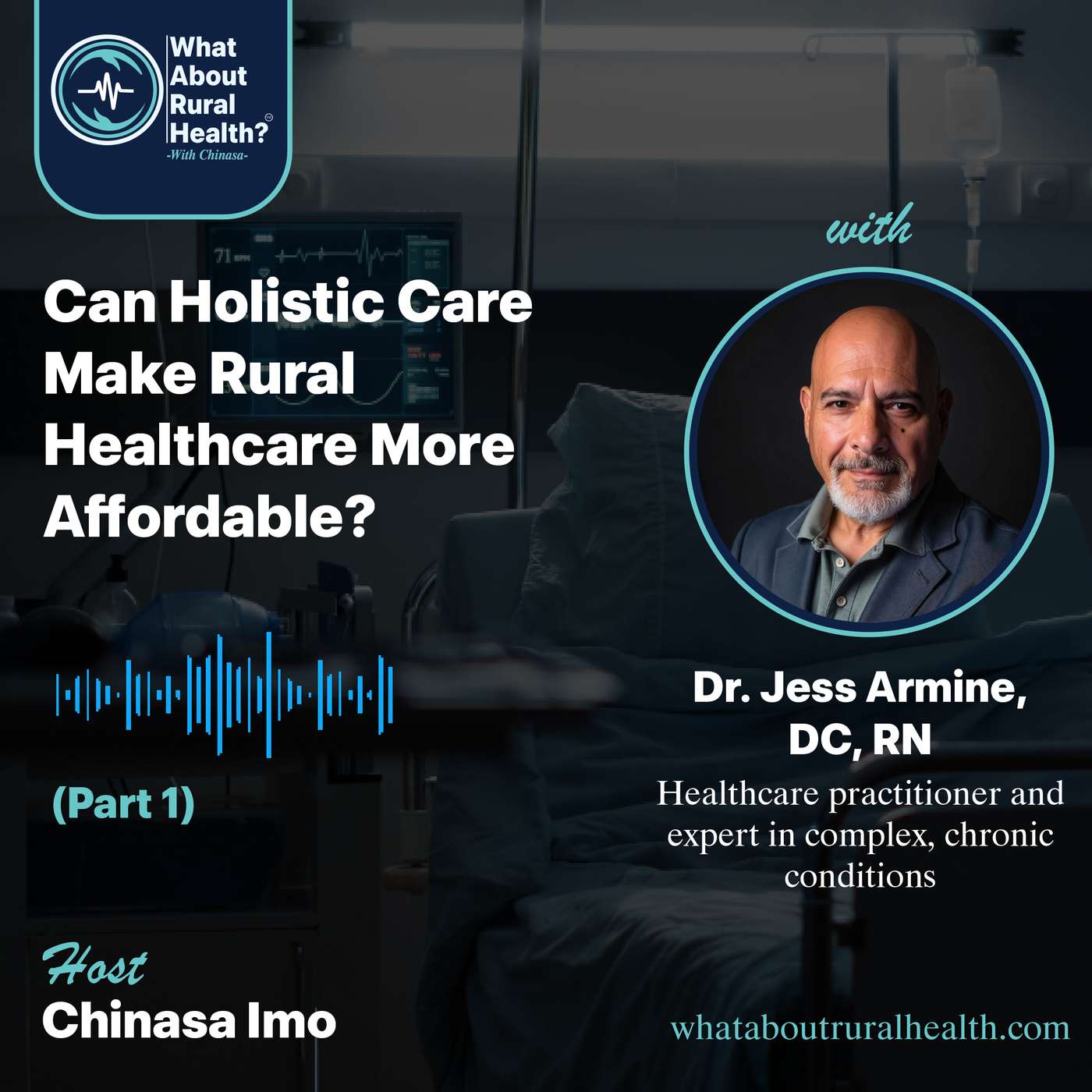
These are examples shared by Dr. Jess Armine, who has spent 50 years in healthcare, starting as an EMT and paramedic in New York City, then a registered nurse, then an Army nurse, before training as a chiropractor and specializing in functional medicine. He discussed rural care models in a conversation with What About Rural Health? With Chinasa Imo.
Distance Is the Root Problem
Distance is the root problem. “In rural communities, the biggest problem is transportation and availability of transportation,” Armine said. Nearly one in five Americans lives in a rural area, and many face drives of 30 miles or more to reach a hospital or specialty provider, a burden that has grown steadily since the early 2000s, according to Texas A&M’s Rural and Community Health Institute.
Enjoying this article? Hear the full conversation with Dr. Jess Armine on What About Rural Health.
Model One: Integrated Local Clinics
The first fix does not require new infrastructure. Instead, new staffing arrangements can be made. Armine described building “a local integrated clinic, which is holistic and traditional medicine together,” pairing a nurse practitioner with a naturopath or a chiropractor trained in functional medicine inside the same practice. That combination handles the bulk of routine care locally, reducing how often patients need to travel at all. It also offers a more stable alternative to the current pattern of rotating nurse practitioners flying in for a few weeks at a time and cycling out, a staffing gap rural clinics have struggled with for years.
Model Two: Telemedicine
For cases beyond what a local team can handle, telemedicine fills in. “Telemedicine works very well because you can have access to these ultra specialists right there,” Armine said, describing both video consultations and robotic telepresence units that let a specialist examine a patient remotely. The format is also fast: “I can speak with somebody for 15 minutes and go right on to the next and next.” That efficiency matters at scale: a 2025 fact sheet from the American Hospital Association notes telehealth continues to reduce unnecessary emergency room visits and hospitalizations by catching problems earlier, even as rural adoption still trails urban and suburban use.
What It Saves
Combined, the two approaches change the cost equation on both sides. “Those kind of collaborative networks work and really save an awful lot of money on both ends,” Armine said. Patients skip the cost and time of long-distance travel, and providers avoid staffing a full specialist roster at every rural site.
None of this requires a policy overhaul. It requires rural systems to build integrated local teams and plug them into existing telehealth networks, an approach that is already proving out in the communities using it.
Want more conversations like this one? Subscribe to the What About Rural Health newsletter for new episodes, articles, and rural health financing insights.
Sources
- Texas A&M Vital Record, “Travel time for health care has increased for both rural and urban Americans”
- American Hospital Association, “Fact Sheet: Telehealth” (Feb. 2025)
- Rural Health Information Hub, “Telehealth and Health Information Technology in Rural Healthcare”
More From This Conversation
- Full transcript: Holistic Care and Rural Healthcare Costs
- Listen to Part 1
- Listen to Part 2
- How Medicine Lost the Generalist Who Knew You
- The Cellular Root of Post-COVID Fatigue
- The Reimbursement Math That Shapes How You Get Treated
- Dr GPT Is Always Ready to See You
Editor’s note: The views in this conversation are the guest’s own and do not necessarily reflect those of What About Rural Health. This article is for information only. It is not medical advice. Please talk to a qualified health professional about your own care.