Healthcare logistics in rural areas determines whether medicines, malaria supplies, equipment, and other essential resources reach the people who need them at the right time.
Part 1 of a two part conversation. Continue with Part 2: Logistics for Life: Behind the Scenes of Rural Health Delivery with Idrissa Rogers.
About this episode
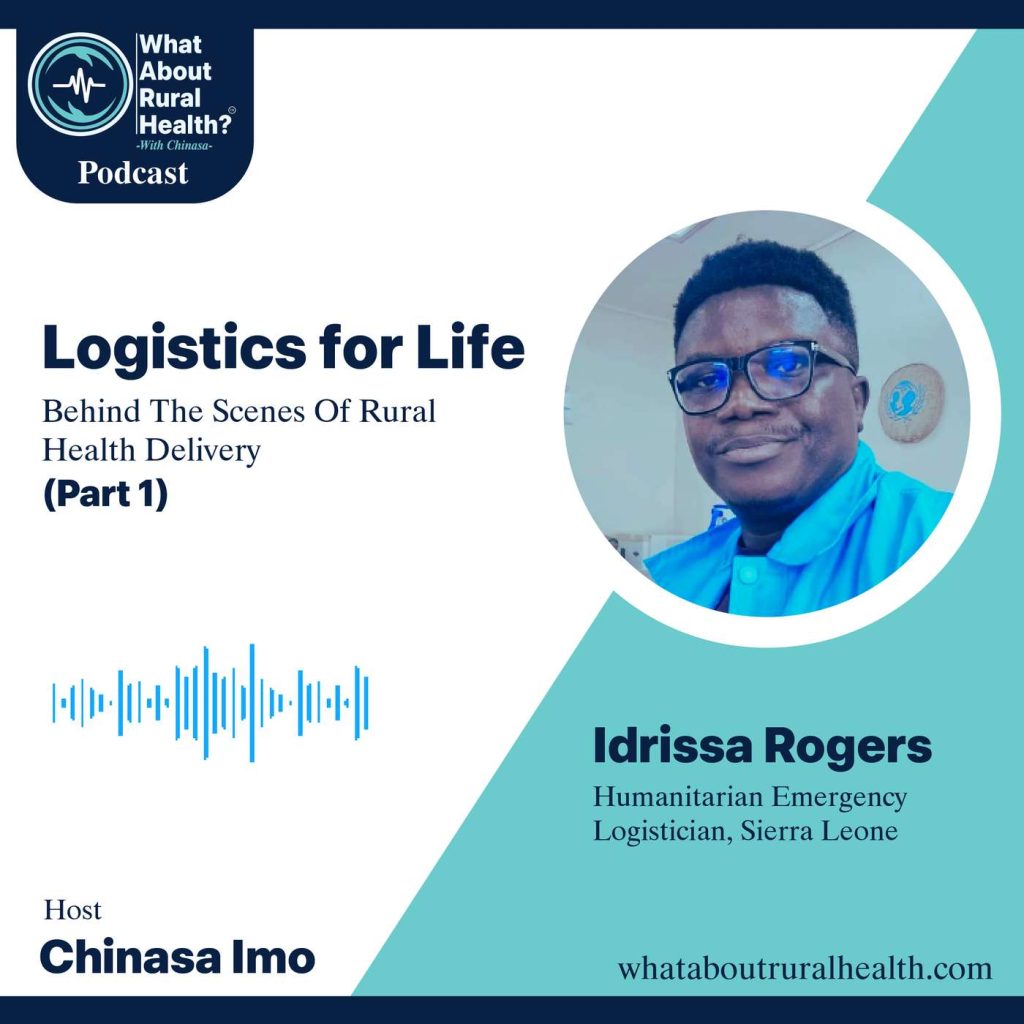
What does it take to deliver lifesaving health supplies to communities that may be reached only by difficult roads, rivers, or local networks? In this episode of What About Rural Health?™, Chinasa Imo speaks with logistics and supply chain professional Idrissa Rogers about the systems, relationships, and decisions behind rural health delivery in Sierra Leone.
Drawing from more than a decade of humanitarian and development experience, Idrissa offers a clear account of the obstacles that appear between a warehouse and a patient. Poor infrastructure, limited transport options, internal bottlenecks, weak coordination, and corruption can all interrupt the movement of essential supplies. His perspective shows why logistics is not a background function. It is a central part of healthcare access.
Why rural healthcare logistics matters
A health program can have strong funding, skilled staff, and effective medical products, but it cannot improve outcomes if supplies do not reach the last mile. Rural communities often face longer routes, seasonal access problems, limited storage, and fewer transportation choices. These conditions make planning and coordination especially important.
Healthcare logistics in rural areas includes forecasting demand, purchasing supplies, storing products safely, tracking inventory, coordinating transport, verifying delivery, and responding when a route or plan fails. Every step affects whether health workers can provide reliable care and whether communities trust the system.
The last mile in Sierra Leone
Idrissa describes the practical realities of serving communities across Sierra Leone, including places where rivers and difficult terrain shape how supplies move. The last mile is rarely one simple trip. It may require several modes of transport, coordination with local partners, careful timing, and an understanding of local conditions that cannot be captured fully in a central plan.
These challenges are not only technical. Delays can determine whether a clinic has the materials needed to prevent disease, treat patients, or respond to an emergency. Reliable delivery therefore depends on people who understand both the supply chain and the communities it serves.
Transparency and accountability
Trust is essential when health materials move through several organizations and locations. Clear records, shared responsibilities, delivery verification, and transparent communication can reduce losses and make it easier to identify where a process has failed.
Idrissa discusses how corruption and internal bottlenecks can weaken even a well funded intervention. Accountability should not be treated as paperwork added after delivery. It needs to be built into procurement, transportation, beneficiary registration, distribution, and reporting from the beginning.
Digital tools and the RED ROSE system
The conversation introduces the RED ROSE system, a digital tool used by UNICEF to onboard beneficiaries and support accountability in the distribution of malaria relief materials. Digital systems can help teams document who is intended to receive support, monitor distribution, and create a clearer record of what happened.
Technology is most useful when it supports strong local processes. A digital platform cannot repair a broken road or replace a trusted field partner, but it can improve visibility, reduce duplication, and help organizations make better decisions. Successful implementation also requires training, reliable data practices, and realistic planning for connectivity and device access.
Local partnerships make delivery possible
Local partners often know which routes remain usable, who can be trusted, when seasonal changes may affect access, and how to communicate with residents. Their knowledge can prevent costly mistakes and make delivery more responsive.
This episode emphasizes that rural logistics works best when communities and local organizations are involved in planning, not contacted only at the point of distribution. Strong partnerships improve access, accountability, and the ability to adapt when conditions change.
The people behind the supply chain
Rural health delivery depends on logisticians, field coordinators, drivers, warehouse teams, data staff, local leaders, and community partners. Their work is often invisible when systems function well, but its importance becomes clear when a shipment is delayed or supplies are missing.
Recognizing these professionals as part of the health workforce can strengthen planning and investment. It also reminds decision makers that healthcare access depends on operational capacity as much as clinical expertise.
About the guest
Idrissa Rogers is a logistics and supply chain professional with more than a decade of experience in humanitarian and development work. His experience provides a practical view of rural distribution, local partnership, accountability, and the systems required to move essential health supplies to remote communities.
Who should listen
- Rural health professionals and healthcare leaders
- Supply chain and logistics professionals
- Humanitarian and development practitioners
- Public health program managers
- Malaria prevention and response teams
- Government agencies, funders, and implementing partners
- Researchers and students studying rural health systems
Frequently asked questions
Why is logistics important in rural healthcare?
Logistics connects health products and services with patients. When forecasting, storage, transport, or delivery fails, clinics may face stockouts and communities may lose access to essential care.
What makes the last mile difficult?
Distance, poor roads, river crossings, seasonal weather, limited vehicles, weak storage, incomplete data, and coordination gaps can all make the final stage of delivery more complex and expensive.
How can digital tools improve health supply chains?
Digital tools can support beneficiary registration, inventory tracking, delivery verification, accountability, and faster decision making. They work best when paired with training, reliable processes, and local knowledge.
Why are local partnerships essential?
Local partners understand geography, relationships, timing, and community expectations. Their involvement helps organizations plan realistic routes, communicate effectively, solve problems, and build trust.
Key topics and search terms
Healthcare logistics in rural areas, rural healthcare supply chain, last mile health delivery, Sierra Leone rural health, humanitarian logistics, medical supply distribution, malaria relief materials, RED ROSE system, UNICEF supply chain, rural healthcare access, digital health logistics, and supply chain accountability.
Main takeaways
- Logistics is a direct part of healthcare access and patient outcomes.
- Last mile delivery requires local knowledge, flexible planning, and trusted partnerships.
- Transparency and accountability should be designed into every stage of distribution.
- Digital tools can improve visibility, but they must support strong human systems.
- Logisticians and field teams are essential members of the rural health workforce.
Resources
About What About Rural Health?™
What About Rural Health?™ is a platform for conversations about rural health equity, access, policy, innovation, and the people working to improve health in underserved communities. Hosted by Chinasa Imo, the podcast connects research, lived experience, and practical solutions across communities and health systems.
Work with What About Rural Health?™
For partnerships, speaking, research, sponsorship, or media inquiries, email info@whataboutruralhealth.com. You can also support the work of What About Rural Health?™.