About this episode
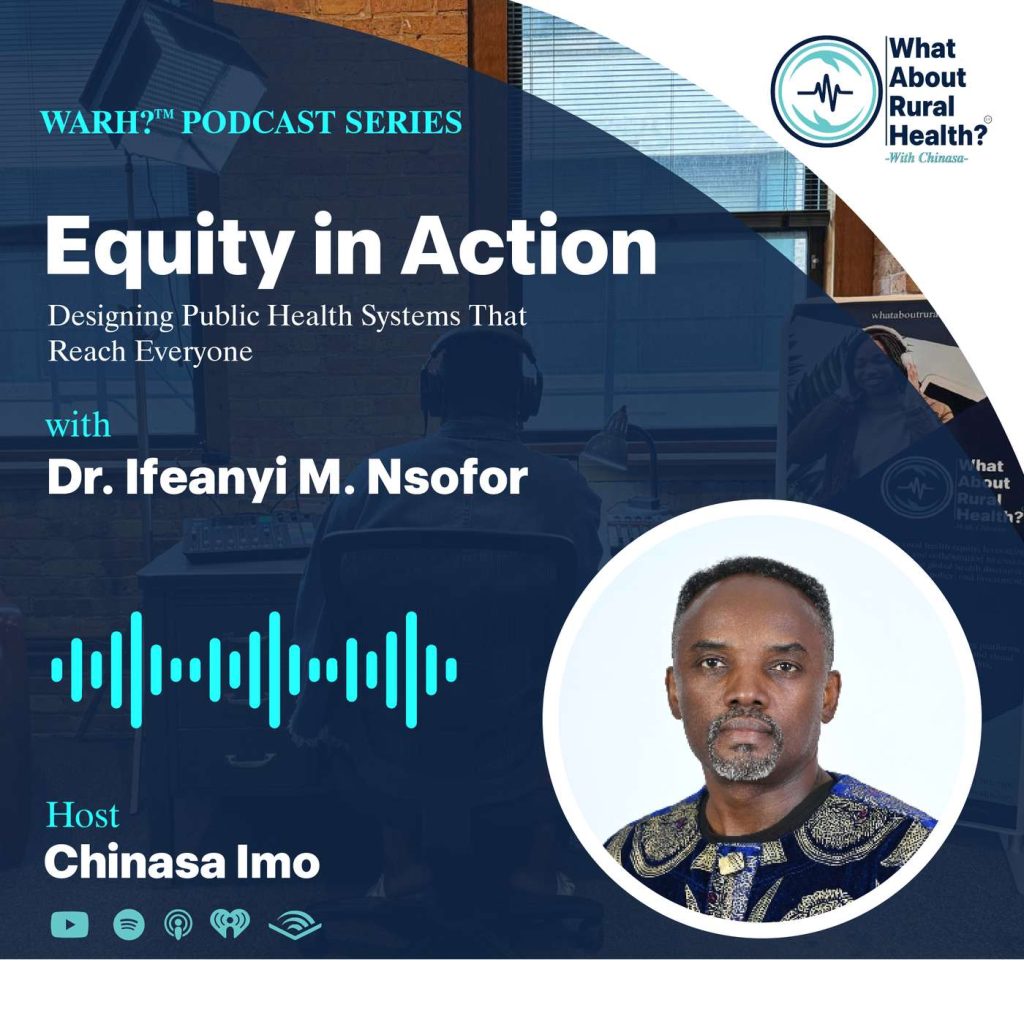
Equitable public health systems can reach rural and underserved communities when equity guides policy, funding, communication, and implementation. In this episode of What About Rural Health?™, public health physician and global health equity advocate Dr. Ifeanyi M. Nsofor joins host Chinasa Imo to explore how inclusive public health systems can turn policy commitments into measurable community impact.
Drawing on his work in African health policy and the VITAL project in Nigeria, Dr. Nsofor discusses vaccine confidence, behavioral science, storytelling, community engagement, and the barriers that prevent rural populations from benefiting equally from public health programs. The conversation shows why successful interventions must be designed with communities, not simply delivered to them.
This episode brings together expert analysis, field experience, and practical lessons for leaders working to improve rural health equity at local, national, and global levels.
Why do some public health systems fail rural communities?
Public health programs can appear successful at the national level while leaving particular communities behind. Rural populations may face long distances to services, health workforce shortages, limited transportation, weak internet connectivity, language barriers, mistrust, and policies built around urban assumptions.
Dr. Nsofor explains that these gaps are not inevitable. They often reflect decisions about whose needs are centered, which evidence is collected, where resources are allocated, and how success is measured. A system designed for equity asks not only how many people were reached, but also who was missed and why.
What does equity in action look like?
Health equity means giving people the support required to achieve fair health outcomes, recognizing that communities do not begin with the same resources or opportunities. Equity in action moves beyond statements of intent. It changes budgets, workforce planning, program design, data collection, accountability, and the way institutions engage communities.
For rural areas, this may include mobile outreach, community health workers, flexible service hours, locally trusted messengers, transportation support, accessible information, decentralized delivery, and funding formulas that account for distance and low population density. These approaches work best when rural residents participate in defining problems and evaluating solutions.
What can vaccine programs teach us about rural health equity?
Vaccination programs demonstrate how access and trust interact. A clinic may have vaccines available, but uptake can remain low when residents lack reliable information, cannot travel to the service point, fear side effects, or do not trust the institutions delivering the program.
Dr. Nsofor shares lessons connected to the VITAL project in Nigeria, including the value of understanding local beliefs and practical barriers before designing an intervention. Community listening can reveal why people make particular health decisions and which messengers are most credible. Programs can then respond with targeted communication, convenient delivery, and feedback mechanisms that respect community priorities.
How can behavioral science improve public health programs?
Behavioral science helps public health teams understand how people interpret risk, make decisions, respond to social norms, and navigate complex systems. It can identify obstacles that are easy for institutions to overlook, such as confusing instructions, inconvenient timing, fear, stigma, or information delivered by an unfamiliar source.
The goal is not to manipulate communities. Ethical behavioral approaches make services easier to understand and use while protecting autonomy. In rural health, this means testing messages with local audiences, reducing unnecessary steps, partnering with trusted leaders, and measuring whether communication produces meaningful access rather than simple awareness.
Why does storytelling matter in health system change?
Data can reveal patterns, but stories show how policies affect people’s daily lives. Responsible storytelling helps decision-makers understand the human consequences of distance, shortages, financial barriers, exclusion, and delayed care. It can also make community-led solutions visible.
Dr. Nsofor and Chinasa discuss storytelling as a tool for advocacy and accountability. When paired with evidence, lived experience can influence policy, challenge assumptions, and build public support. Ethical storytelling should preserve dignity, avoid stereotypes, and ensure that rural people are represented as partners and problem-solvers rather than passive recipients.
About the guest
Dr. Ifeanyi M. Nsofor is a public health physician, global health equity advocate, and influential voice in African health policy. His work connects health systems, vaccine confidence, behavioral science, community engagement, and public communication. In this episode, he offers practical insight into translating health equity from principle into action.
Who should listen?
- Public health leaders and health system decision-makers
- Rural hospitals, clinics, and community health programs
- Policymakers and global health funders
- Community health workers and patient advocates
- Vaccination and health communication teams
- Behavioral science and implementation research professionals
- Students and researchers focused on health equity and African health systems
Frequently asked questions
What is an equitable public health system?
An equitable public health system identifies which populations face the greatest barriers and directs resources, services, and accountability toward achieving fair outcomes rather than offering every community an identical response.
Why is community engagement important in public health?
Community engagement improves relevance, trust, and sustainability. It helps teams understand local priorities, test assumptions, select credible messengers, and design services that people can realistically use.
How does behavioral science support vaccine uptake?
Behavioral science examines the beliefs, social influences, practical barriers, and decision environments that affect vaccination. These insights can improve messaging, service design, convenience, and trust.
Can storytelling influence health policy?
Yes. When used ethically alongside reliable evidence, storytelling can clarify the effects of policy, elevate lived experience, demonstrate local solutions, and help decision-makers understand why change is needed.
Key topics and search terms
Equitable public health systems, designing public health systems, rural health equity, equitable healthcare access, African health policy, vaccine uptake, vaccine confidence, behavioral science in public health, community engagement, rural healthcare barriers, health communication, implementation science, underserved communities, and Dr. Ifeanyi Nsofor.
What are the main takeaways?
Public health systems reach everyone only when equity is built into their design, financing, communication, and evaluation. Rural communities must be included in decisions, and success must be measured by who benefits as well as how many people are served.
Behavioral science, trusted local partnerships, accessible services, and ethical storytelling can help translate policy into practice. Lasting change begins by listening to communities and treating their knowledge as essential public health evidence.
Resources
- Explore more episodes of What About Rural Health?™
- Learn more about host Chinasa Imo
- Share your rural health story: info@whataboutruralhealth.com
About What About Rural Health?™
What About Rural Health?™ is a global platform for rural health equity, using conversations, digital storytelling, advocacy, and collaboration to bring rural healthcare challenges and solutions into public and policy discussions.
Work with What About Rural Health?™
For partnerships, speaking, sponsorship, research collaboration, or story submissions, email info@whataboutruralhealth.com. You can also support the work of What About Rural Health?™.