About this episode
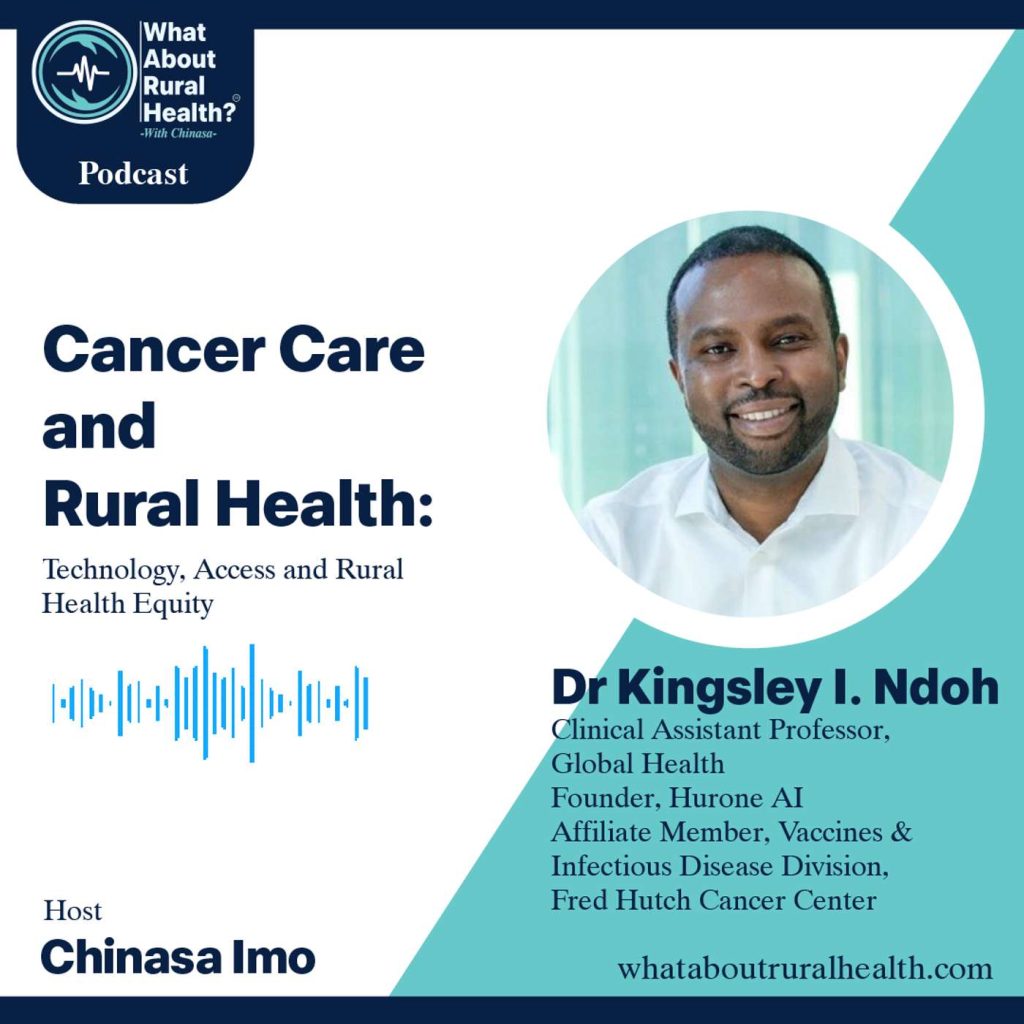
Rural cancer care technology can help close gaps in oncology access when it supports patients, strengthens clinical teams, and responds to the realities of underserved communities. In this episode of What About Rural Health?™, Dr. Kingsley I. Ndoh, founder and CEO of Hurone AI, joins host Chinasa Imo to discuss artificial intelligence, patient navigation, health equity, and the future of cancer care in rural and resource-limited settings.
Dr. Ndoh explains why cancer outcomes are shaped not only by diagnosis and treatment, but also by whether patients can reach specialists, understand their care plans, manage symptoms between visits, and remain connected to their care teams. The conversation explores how AI and health data may support clinicians, reduce communication gaps, and improve continuity of care without losing the human relationship at the center of medicine.
The episode also considers a crucial question for innovators and funders: how can technology be designed so it expands access instead of reproducing existing rural and urban disparities?
Why is rural cancer care access unequal?
People living in rural communities may face long travel distances, fewer oncology specialists, limited diagnostic capacity, workforce shortages, fragmented referrals, and difficulties accessing timely follow-up. These barriers can delay diagnosis, interrupt treatment, and place additional financial and emotional pressure on patients and families.
Rural cancer care technology cannot replace oncologists, nurses, navigators, or community health workers. It can, however, help teams communicate more consistently, identify concerns earlier, organize information, and maintain contact between appointments. When designed around real workflows, digital tools can extend the reach of scarce expertise.
How can AI support cancer patients and clinical teams?
AI can assist with patient navigation, symptom reporting, communication, triage support, and the organization of clinical and social information. In the episode, Dr. Ndoh demonstrates Hurone AI’s patient-centred approach and discusses how technology can help patients receive understandable guidance while alerting healthcare teams when human attention is needed.
Safe use requires clear clinical oversight, privacy protection, reliable evidence, transparent governance, and careful escalation pathways. AI should support professional judgment rather than present itself as an independent substitute for diagnosis or treatment. For rural systems, usability and affordability are just as important as technical sophistication.
What role do health data and patient navigation play?
Good cancer care depends on what happens between clinical visits. Patients may need help understanding symptoms, managing side effects, completing referrals, locating financial or transportation support, and knowing when to contact a clinician. Patient navigation connects these moving parts.
Responsible use of health data can help teams recognize patterns and prioritize follow-up. Yet incomplete data, biased datasets, poor connectivity, and weak interoperability can limit performance. Rural communities must be represented in the design, testing, and evaluation of digital cancer care systems.
How can technology advance rural health equity?
Technology advances equity when it reduces a barrier that patients actually experience. That may mean plain-language information, culturally responsive communication, remote monitoring, better referral coordination, or tools that help overstretched teams focus attention where it is most needed.
Dr. Ndoh’s perspective connects innovation with investment. Sustainable rural cancer care technology needs financing, clinical partnerships, community trust, and integration with existing health systems. A promising pilot is not enough if communities cannot afford, maintain, or govern it over time.
About the guest
Kingsley I. Ndoh, MD, MPH is a physician-entrepreneur, founder and CEO of Hurone AI, and a clinical academic working at the intersection of oncology, global health, artificial intelligence, and patient navigation. His work focuses on improving continuity and equity in cancer care through clinically governed technology.
Who should listen?
- Oncology professionals, nurses, and patient navigators
- Rural hospitals, clinics, and health system leaders
- Digital health, health AI, and telehealth teams
- Public health practitioners and community health workers
- Policymakers, funders, and healthcare investors
- Researchers and students focused on cancer disparities and health equity
- Patients, caregivers, and advocates interested in more accessible cancer care
Frequently asked questions
What is rural cancer care technology?
Rural cancer care technology includes digital tools that support access, communication, navigation, symptom monitoring, referrals, and coordination for patients who live far from specialist cancer services.
Can AI diagnose cancer without a clinician?
AI may assist trained professionals with information and decision support, but it should not replace clinical evaluation, diagnosis, or treatment planning. Safe systems include human oversight and clear escalation to qualified care teams.
How can telehealth improve oncology access?
Telehealth can reduce some travel, connect rural clinicians with specialists, support follow-up, and make patient education more accessible. Its impact still depends on connectivity, affordability, digital literacy, privacy, and local clinical capacity.
Why is patient navigation important in cancer care?
Navigation helps patients move through screening, diagnosis, treatment, referrals, and supportive services. It can reduce confusion and help address practical barriers such as transportation, communication, and continuity between visits.
Key topics and search terms
Rural cancer care technology, AI in oncology, cancer care disparities, rural oncology access, cancer patient navigation, telehealth for cancer care, health equity, digital health, remote symptom monitoring, underserved communities, healthcare innovation, and clinically governed AI.
What are the main takeaways?
Rural cancer care technology is most valuable when it solves practical access and coordination problems, protects patients, and works alongside trusted clinicians. AI can strengthen navigation and communication, but lasting impact requires infrastructure, evidence, community participation, and sustainable investment.
For health systems and innovators, the priority is not simply deploying more technology. It is building accountable tools that help rural patients remain connected to high-quality cancer care throughout their journey.
Resources
- Learn more about Hurone AI
- Read the official profile of Dr. Kingsley I. Ndoh
- Explore more episodes of What About Rural Health?™
- Learn more about host Chinasa Imo
- Share your rural health story: info@whataboutruralhealth.com
About What About Rural Health?™
What About Rural Health?™ is a global platform for rural health equity, using conversations, digital storytelling, advocacy, and collaboration to bring rural healthcare challenges and solutions into public and policy discussions.
Work with What About Rural Health?™
For partnerships, speaking, sponsorship, research collaboration, or story submissions, email info@whataboutruralhealth.com. You can also support the work of What About Rural Health?™.