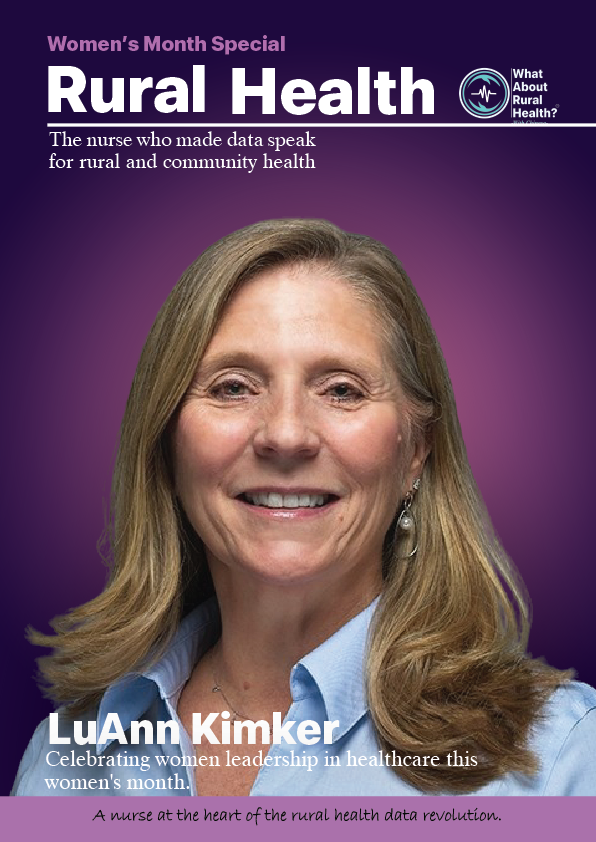
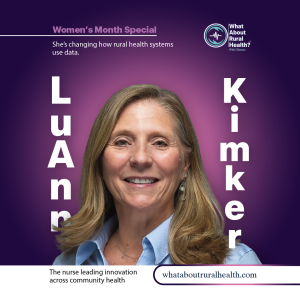
As March shines its spotlight on women leadership, we turn to LuAnn Kimker, RN, MSN, a data-savvy nurse-executive reshaping how Federally Qualified Community Health Centers use information to advance care, equity, and innovation for millions of Americans.
A nurse at the heart of the data revolution
LuAnn Kimker began her career where care is most immediate, at the bedside and in the clinic. As a nurse leader at the Joslin Diabetes Center, she oversaw clinical programs, quality metrics, and patient education initiatives for thousands of patients managing complex chronic conditions.
She later expanded her impact through leadership roles spanning clinical care, community health, and healthcare technology, where she focused on improving care delivery, quality outcomes, and clinical operations.
It was through these experiences that she encountered a quiet but critical gap: care was deeply human, but the systems supporting it were often fragmented, complex, and difficult to use.
From that frontline and leadership experience, she built a second career, one focused on transforming data into something clinicians can act on in real time. Today, as Senior Vice President of Clinical Innovation at Azara Healthcare, she leads efforts supporting more than 1,000 Federally Qualified Community Health Centres and primary care providers across 43 states, collectively serving over 25 million Americans.
From electronic health records to equity, a data-driven mission
Before stepping into executive leadership at Azara Healthcare, LuAnn worked extensively at the intersection of clinical care and health information technology, supporting organisations through major healthcare transformation initiatives.
Her experience includes guiding providers through:
- Patient Centred Medical Home (PCMH) transformation
- Accountable Care Organisation (ACO) models
- Meaningful Use programs
- Electronic Health Record (EHR) implementation and optimisation.
These roles positioned her as a key bridge between clinical teams and data systems, helping organisations translate complex data into practical, everyday decision-making.
Her mission has always been grounded in clarity and equity:
- Make data usable, not overwhelming, for care teams
- Use insights to close gaps in chronic conditions like diabetes and hypertension
- Help rural and community health systems survive and succeed in value-based care
Through collaborations with organisations like the American Medical Association, she has supported initiatives that improve blood pressure control and quality metrics, directly impacting underserved populations, including women and families.
Leading the healthcare frontier for community health
At Azara Healthcare, LuAnn plays a central role in advancing the use of population health analytics platforms, including tools like the DRVS system, which enable healthcare providers to identify care gaps, monitor patient populations, and improve preventive care delivery at scale.
At national platforms such as the NACHC Partner Conference, she speaks on value-based care, payer integration, and the role of data in strengthening community health systems.
Her most powerful insights, however, come from the field. In one example, health systems used automated outreach, text messages and digital reminders to connect patients to overdue screenings. What was once a manual, staff-heavy process became scalable, freeing up human resources while improving care delivery.
It is a model she returns to often: use automation where possible, preserve human touch where it matters most.
Innovation under pressure
In a system under strain, innovation can feel risky, if not impossible.
But LuAnn reframes it:
“Responsible innovation isn’t about doing everything at once. It’s about trying something, measuring it, and adjusting.”
In rural health, that might mean:
- Sharing data across organisations to avoid duplicate tests
- Integrating behavioural health with primary care
- Partnering with community services around food or housing insecurity
- Using simple tools to identify high-risk patients and intervene earlier
The key is not perfection; it is iteration. And critically, leadership:
“The organisations that succeed are the ones where leaders create space to try, fail, and adapt.”
Why she embodies Women’s Month energy
LuAnn may not be a traditional “women’s health” specialist, yet her impact on women’s health is profound. She supports systems that serve women, children, and low-income families. She advances care models that improve preventive services, chronic disease management, and access.
In a space where healthcare, data science, and technology often intersect in male-dominated environments, she represents something powerful: a nurse not just participating in the data revolution, but leading it.
Closing
In a world where “big data” can feel distant and impersonal, LuAnn Kimker brings something rare: a nurse’s empathy, a systems thinker’s clarity, and a reformer’s drive.
She reminds us that behind every dataset is a person. Behind every metric, a community.
And in this moment, where rural health systems are being pushed to their limits, her work offers something essential: not just better data, but better decisions. Not just innovation, but intention.
This Women’s Month, she stands as a quiet force at the frontier of community health, ensuring that the people most often overlooked are finally seen, counted, and cared for.
Also Read: When the Healthcare System Fails: Lessons from Dr. Peter Kowey