When Health Systems Fail (B) | Peter Kowey
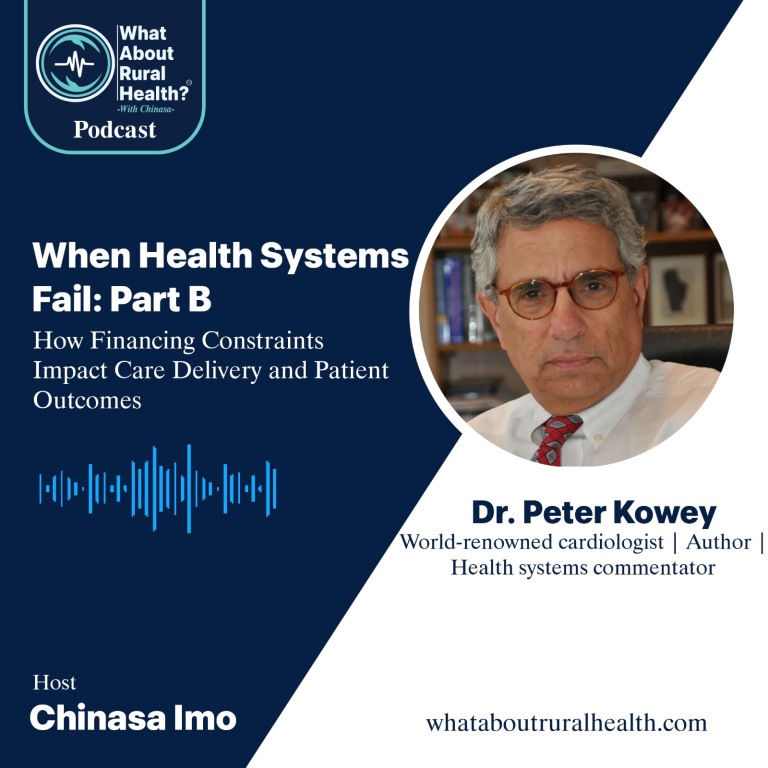
In episode (B) of When Health Systems Fail, world-renowned cardiologist, Dr Peter Kowey, discusses the importance of individualized care in modern medicine. He explains how clinicians can move beyond rigid, algorithm-driven treatment models by engaging patients directly, understanding their unique conditions, and involving them in final care decisions. By strengthening these one-on-one relationships, physicians can help counter some of the pressures created by administrative control and corporate influence over clinical practice. #podcast #healthequity #ruralhealth #interview #healthcare Want to be a guest on What About Rural Health?™? Send Chinasa Imo a message on PodMatch, here: https://www.podmatch.com/hostdetailpreview/chinasaimo Failure To Treat In his latest book, Dr. Peter Kowey examines the deep structural failures within the American healthcare system through a powerful collection of composite true stories. He highlights how patients and practitioners are harmed by systemic issues such as insurance denials, physician burnout, and administrative overload. Each story unpacks a common healthcare challenge and ends with practical guidance to help patients and caregivers better navigate the system. Need for Regulation of Corporatisation Dr Kowey argues that the growing corporatisation of healthcare has led large corporations to acquire small hospitals and medical practices, giving them control over how care is delivered. These entities influence physicians, patients, and insurers, often prioritising profit over patient well-being. Incentivising for a Better System He notes that the current healthcare system rewards procedures and operations over patient-centred care, leading to major pay gaps between specialists and primary care physicians. To improve outcomes, compensation models should prioritise time spent caring for patients over the volume of procedures. Conclusion He closes with the assertion that Healthcare workers are heroes and he hopes that this book helps them be more appropriated. Get the book here: https://url-shortener.me/F91H Connect with him on: https://www.peterkoweyauthor.com/ Subscribe, share your thoughts, and stay connected. Follow us on all platforms: https://linktr.ee/whataboutruralhealth?utm_source=linktree_profile_share<sid=bd8711f7-e355-4d5d-a9c4-80816136b873
When Health Systems Fail (A) | Dr Peter Kowey
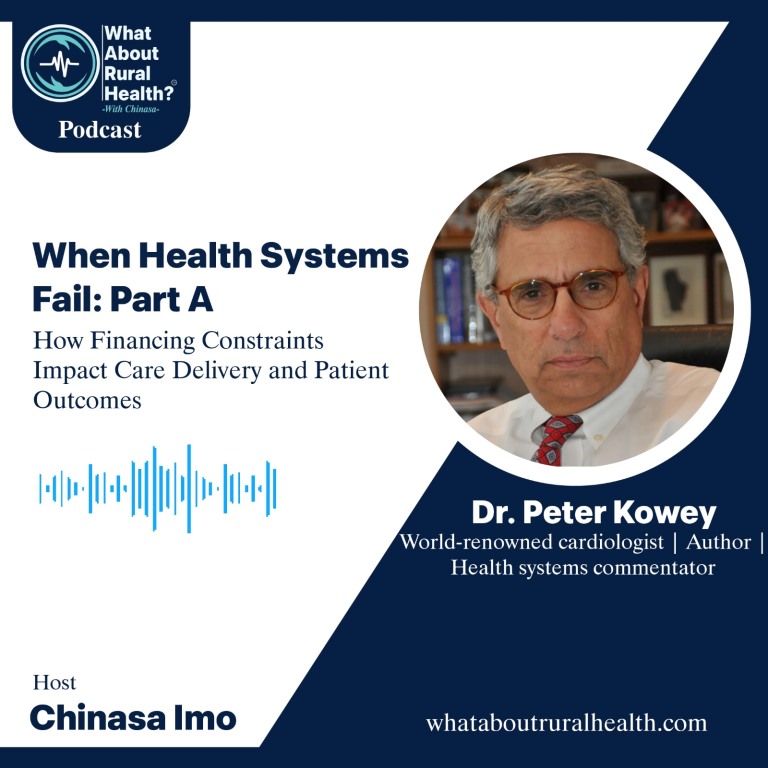
In this episode (A) of Rethinking Rural Health Financing, world-renowned cardiologist, Dr Peter Kowey, explains the bureaucracy involved in achieving positive health system outcomes, especially with medical insurance companies. He also laments the adverse effects the cut in Medicaid would bring to healthcare across America. #podcast #healthequity #ruralhealth #interview #healthcare Want to be a guest on What About Rural Health?™? Send Chinasa Imo a message on PodMatch, here: https://www.podmatch.com/hostdetailpreview/chinasaimo Failure To Treat In his latest book, Dr. Peter Kowey examines the deep structural failures within the American healthcare system through a powerful collection of composite true stories. He highlights how patients and practitioners are harmed by systemic issues such as insurance denials, physician burnout, and administrative overload. Each story unpacks a common healthcare challenge and ends with practical guidance to help patients and caregivers better navigate the system. Need for Regulation of Corporatisation Dr Kowey argues that the growing corporatisation of healthcare has led large corporations to acquire small hospitals and medical practices, giving them control over how care is delivered. These entities influence physicians, patients, and insurers, often prioritising profit over patient well-being. Incentivising for a Better System He notes that the current healthcare system rewards procedures and operations over patient-centered care, leading to major pay gaps between specialists and primary care physicians. To improve outcomes, compensation models should prioritise time spent caring for patients over the volume of procedures. Conclusion He closes with the assertion that Healthcare workers are heroes and he hopes that this book helps them be more appropriated. Get the book here: https://url-shortener.me/F91H Connect with him on: https://www.peterkoweyauthor.com/ Subscribe, share your thoughts, and stay connected. Follow us on all platforms: https://linktr.ee/whataboutruralhealth?utm_source=linktree_profile_share<sid=bd8711f7-e355-4d5d-a9c4-80816136b873
Excluded Voices (B): Financing Care for Deaf and Disabled Communities in Rural Health Systems | Grace Lester
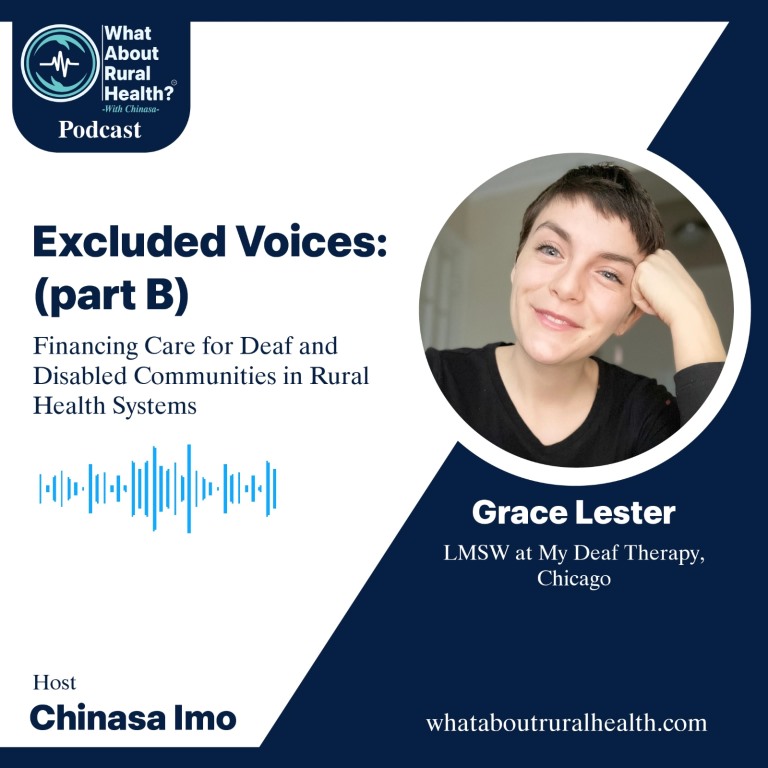
A man sits in jail for murder because of a deaf misinterpretation. Listen to the story. #Deaf #story #ruralhealth #policy In part B of the conversation, Grace Lester talks about the nature of inclusivity, accommodation and the basic necessity of it. She also gives insight into her book, which dives into the stories and experiences of deaf people in incarceration and better approaches to creating a better society for people experiencing deafness. Want to be a guest on What About Rural Health?™? Send Chinasa Imo a message on PodMatch, here: https://podmatch.com/hostdetailpreview/chinasaimo Listen in on your favorite streaming platforms via the link: https://linktr.ee/whataboutruralhealth?utm_source=linktree_profile_share<sid=51344927-ccb5-4251-a16d-198a18d47ea8 Listen in on your favorite streaming platforms via the link: https://pod.fo/e/3936ea
Excluded Voices (A): Financing Care for Deaf and Disabled Communities in Rural Health Systems | Grace Lester
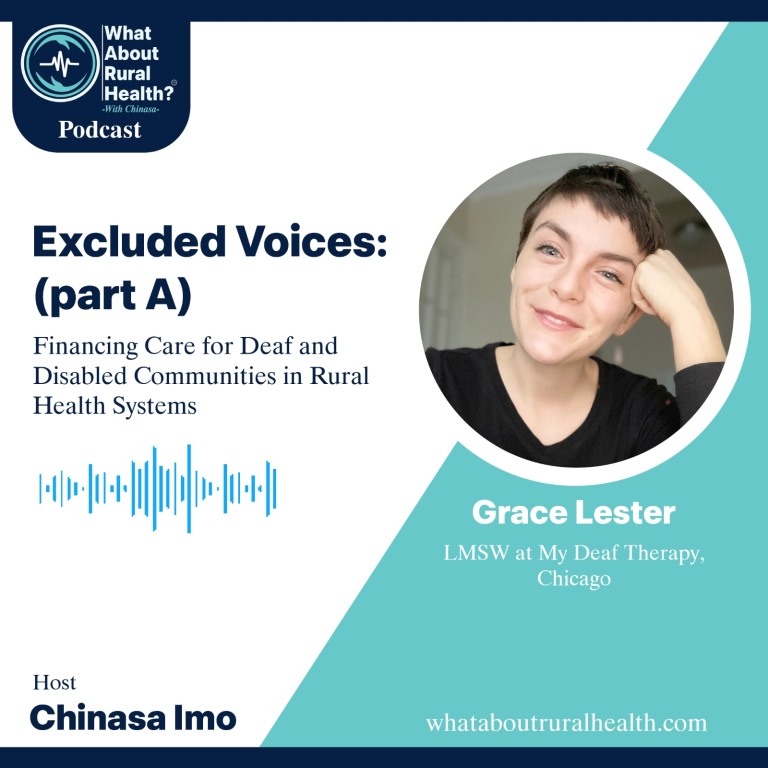
How do members of the deaf and disabled community navigate the health system in rural areas and structures? #healthequity #healthcare #deafcommunity #ruralhealth Grace Lester, a clinician and advocate for Deaf communities, joins the podcast to shed light on the lives of the disabled in incarceration and in the community in general – their problems, peculiarities, and needs. Want to be a guest on What About Rural Health?™? Send Chinasa Imo a message on PodMatch, here: https://podmatch.com/hostdetailpreview/chinasaimo Listen in on your favorite streaming platforms via the link: https://linktr.ee/whataboutruralhealth?utm_source=linktree_profile_share<sid=51344927-ccb5-4251-a16d-198a18d47ea8 Listen in on your favorite streaming platforms via the link: https://pod.fo/e/3936ea
Bridging the Gap: Why Rural Health Needs Sustainable Funding with Tariah Adams (Part B)
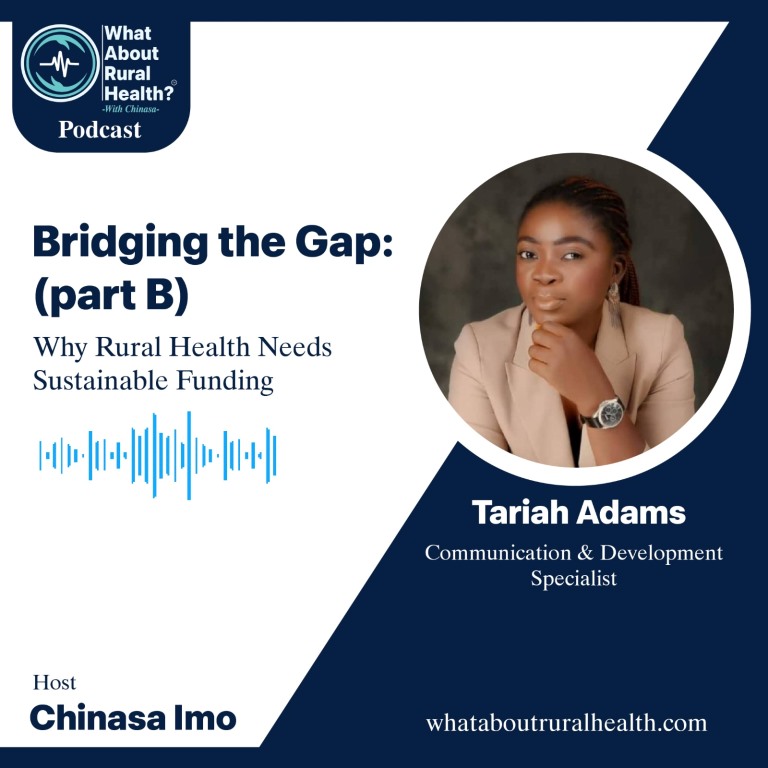
What does sustainable rural health financing look like in practice? In Part B of Bridging the Gap, we move from diagnosis to solutions. From a community in Kebbi State, Nigeria — where women created a database of unvaccinated children and actively requested immunisation services – to broader structural questions about political will and local ownership, this episode explores what actually makes rural health interventions succeed. We discuss why: Political will determines whether funding translates into real care Community trust is the foundation of effective health delivery Local ownership must be central to policy communication Partnership coordination strengthens rural health systems Emergency response systems often receive tools and resources that routine rural services never do Why is performance high during outbreaks — but fragile in everyday healthcare? We also challenge a critical assumption in rural health financing: policymakers must unlearn the belief that volunteers can indefinitely fill systemic gaps without sustainable funding. Listening to communities is not optional — it is essential. Want to be a guest on What About Rural Health?™? Send Chinasa Imo a message on PodMatch, here: https://www.podmatch.com/hostdetailpreview/chinasaimo
Bridging the Gap: Why Rural Health Needs Sustainable Funding with Tariah Adams (Part A)
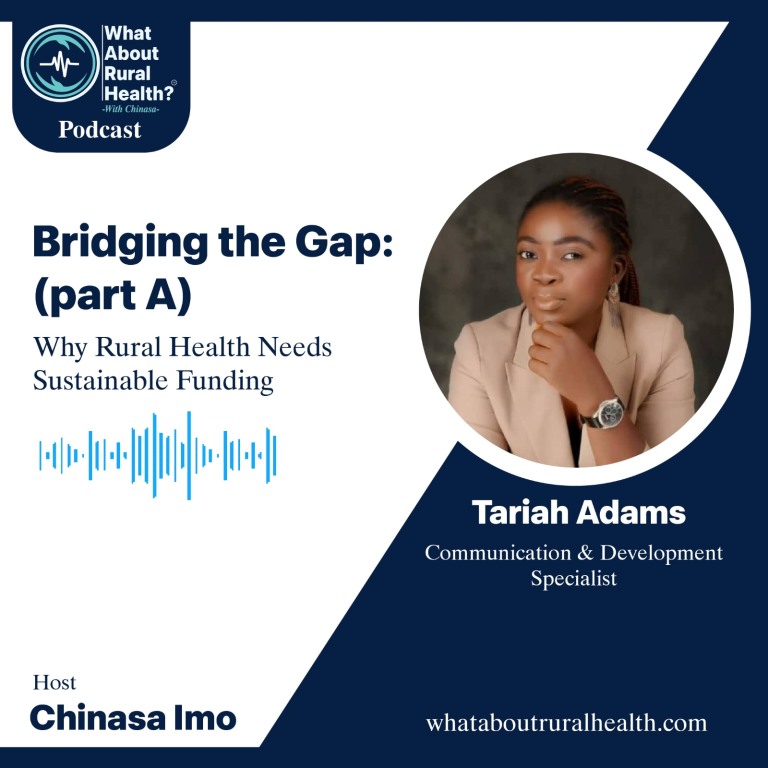
In this first episode of Rethinking Rural Health Financing, Bridging the Gap: Why Rural Health Needs Sustainable Funding, Chinasa speaks with Tariah Adams to unpack the structural reasons rural health financing continues to fail communities. Tariah explains how most rural health funding is misaligned—designed to respond to crises rather than stabilise health systems. She highlights how project-based and politically driven funding models favour short-term, measurable outcomes, while rural health challenges are lived daily and require long-term investment. She also points to a critical gap: many funding decisions are made by policymakers far removed from rural lived realities, resulting in budgets that exist on paper but fail in practice. The conversation explores what underfunding really looks like on the ground—from hospitals that exist only in name, to self-medication, unfunded health worker postings, and communities left without care. Tariah emphasises that true success in rural health financing can only be measured by community feedback and involvement, and she calls on rural communities to innovate and take part in shaping solutions rather than waiting for change. This episode sets the tone for a series that asks hard questions about power, priorities, and justice in rural health. Want to be a guest on What About Rural Health?™? Send Chinasa Imo a message on PodMatch, here: https://www.podmatch.com/hostdetailpreview/chinasaimo
What happens after people flee violence, climate disasters, and instability — and where do they go when the headlines fade?
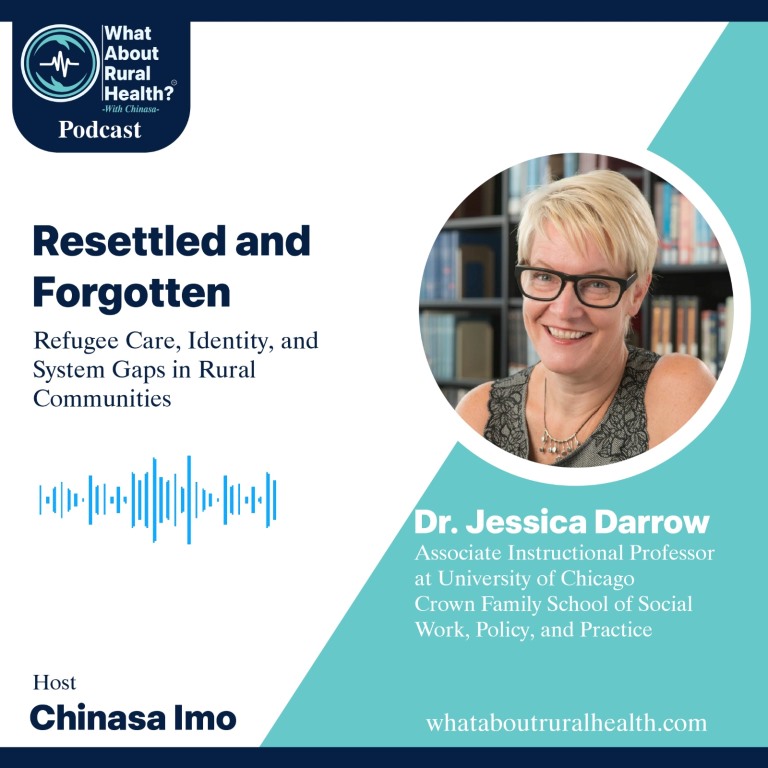
In this episode of What About Rural Health, we sit down with Dr. Jessica Darrow, Associate Instructional Professor at the University of Chicago Crown Family School of Social Work, Policy, and Practice, to unpack the hidden layers of the global refugee and migration crisis, especially as it intersects with healthcare in rural and underserved communities. Dr. Darrow challenges the way migration is often framed, pointing out that climate change is an overlooked driver of displacement, even though those affected are rarely recognized as refugees under international definitions. She also highlights a troubling global paradox: as migration increases, borders are becoming more militarized and closed. Drawing on global perspectives from Kenya, Germany, and the United States, this conversation explores a powerful shift in thinking, from viewing healthcare as a limited resource to recognizing it as a fundamental human right. Dr. Darrow explains how this lens changes how refugee and host communities are treated, supported, and integrated. We also examine the gap between policy and practice, where national frameworks often fail to reflect the realities faced by communities on the ground; particularly around mental health, social welfare, and long-term stability. This episode invites us to rethink care, belonging, and responsibility in a world on the move, and asks a crucial question: who gets to feel at home, and who gets left behind? Listen, reflect, and join the conversation. Want to be a guest on What About Rural Health?™? Send Chinasa Imo a message on PodMatch, here: https://podmatch.com/hostdetailpreview/1762029634065133df1c28412
Community First: How Policy, Psychology & People Power Transform Rural Health with Titilayo Ogunbambi
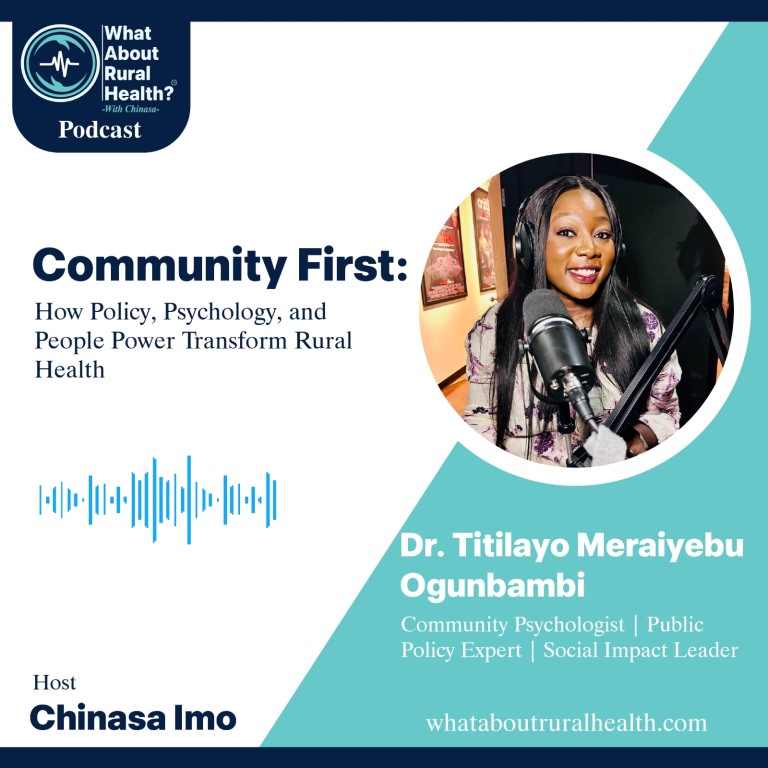
In this thought-provoking episode of What About Rural Health?, host Chinasa Imo sits with Dr. Titilayo Ogumbambi, a public health expert whose work blends psychology, policy, and community development to reshape health outcomes in underserved areas. Dr. Titilayo breaks down the real barriers rural communities face — from lack of transportation and inadequate financing to shortages of skilled community health workers. She also highlights the less-visible obstacles: fear, stigma, mistrust, and deep psychosocial burdens that shape how people seek and respond to care. The conversation dives into the complex layers of gender-based violence, reminding us that GBV cannot be treated as a single issue, but as the outcome of intertwining social, cultural, and economic realities. Dr. Titilayo introduces the Asset-Based Community Development (ABCD) model, showing how communities can unlock their own strengths — social networks, informal support systems, and local leadership — to drive sustainable change. She also speaks to the power and resilience of refugees living in rural areas, and why supporting them strengthens entire communities. On public policy, she emphasises a hard truth: Nigeria doesn’t lack policies; it lacks implementation. Without proper follow-through, the best ideas remain only ideas. From trauma-informed care to community-driven development, this episode is a reminder that rural health transformation isn’t just about medicine; it’s about people, power, and the systems that connect them. Want to be a guest on What About Rural Health?™? Send Chinasa Imo a message on PodMatch, here: https://podmatch.com/hostdetailpreview/1762029634065133df1c28412
Frontlines & Frameworks With Peterson Wachira

In this episode, we sit with Peterson Wachira, a seasoned Clinical Officer, Infectious Disease Expert, and National Chairperson of the Kenya Union of Clinical Officers (KUCO) — and a recipient of the Head of State Commendation Award. Wachira offers an unfiltered look into Kenya’s health system — breaking it down from Level 1 community centers to Level 6 national hospitals, while highlighting how primary healthcare truly begins at the grassroots. He discusses: The crucial distinction between medical officers and clinical officers The 360° approach to bettering healthcare for both workers and patients How systemic failures during Ebola and COVID-19 exposed gaps in preparedness Why pandemic readiness must be proactive, not reactive The shortage of clinical officers and the impact on rural healthcare delivery How community health promoters are empowering citizens to demand stronger health policies during elections, Want to be a guest on What About Rural Health?™? Send Chinasa Imo a message on PodMatch, here: https://podmatch.com/hostdetailpreview/1762029634065133df1c28412 Listen to this powerful conversation on the realities, lessons, and hope within Kenya’s healthcare system.
Logistics for Life (Part 2): Behind The Scenes Of Rural Health Delivery
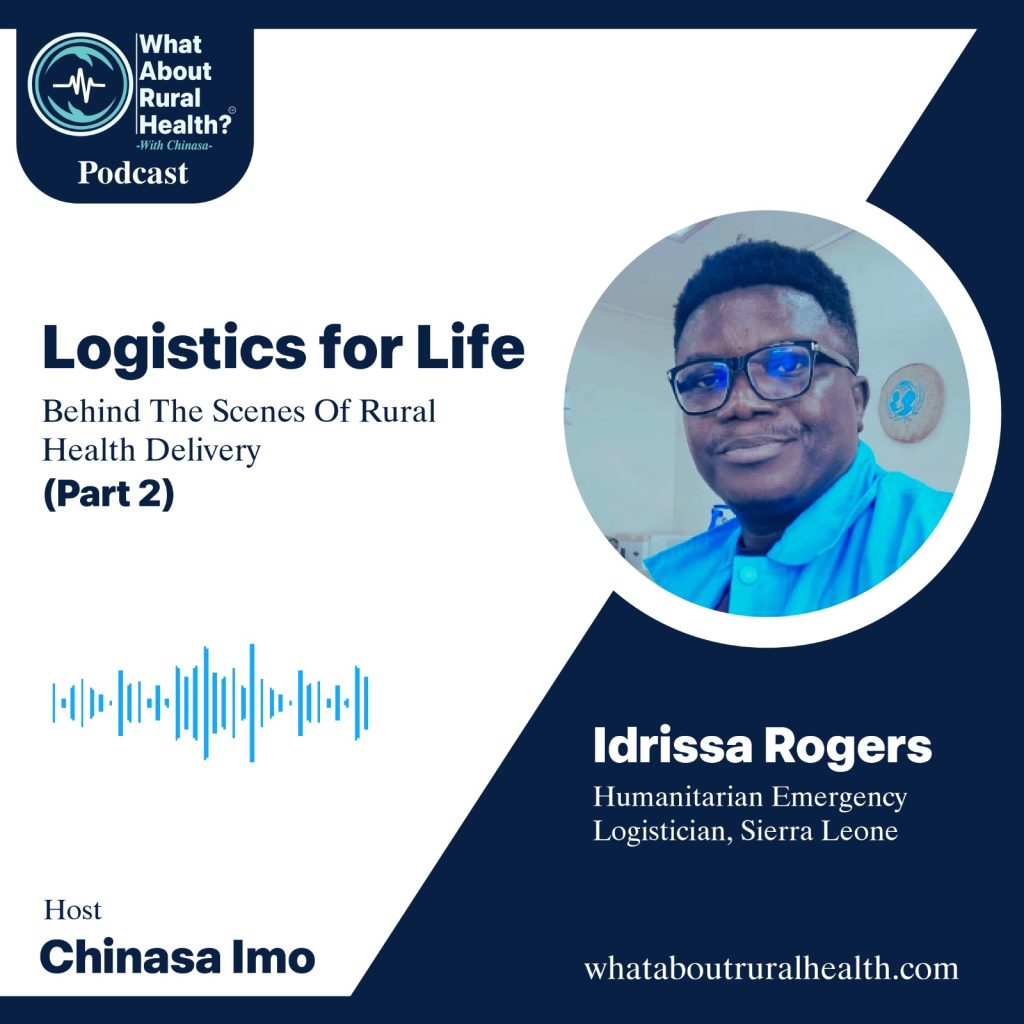
In this second part of our conversation with Idrissa Rogers, a seasoned logistics and supply chain professional with over a decade of experience in humanitarian and development work, we dive deeper into the real challenges and hard truths shaping rural healthcare delivery. Idrissa sheds light on: The unpredictability of transport systems and why every logistics plan needs a backup plan. The cracks within rural healthcare supply chains — from systemic corruption to apathy toward innovation. The rise of innovative tools like iPads and digital systems transforming field logistics. And most importantly, the selfless mindset required to truly thrive in health logistics. This episode is a must-listen for anyone passionate about health systems, logistics, innovation, and impact work in underserved communities. Subscribe to stay updated on new episodes of What About Rural Health?™ — where we share real stories, real challenges, and real change from the field. #RuralHealth #Logistics #HealthcareInnovation #WARHPodcast #WhatAboutRuralHealth #PublicHealth #HumanitarianWork