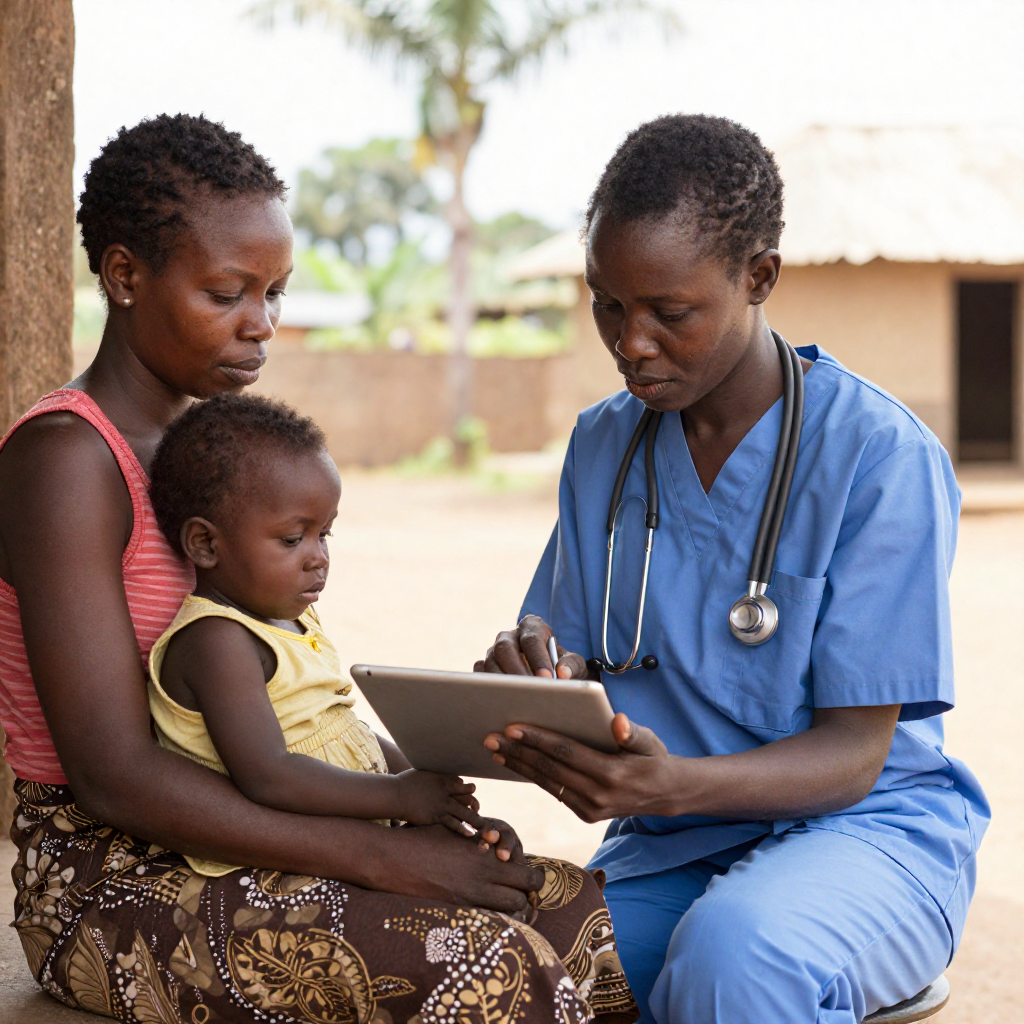
Aisha, a young mother, wakes up before sunrise to discover her son has a fever.
The closest health facility in her village is more than 15 kilometres away. They have no ambulance, no transport, and no guarantee that a doctor will even be available if she gets there.
She’s confused. Walking the journey is a risk; sitting to hope the scare passes is riskier.
This is the dilemma millions of rural dwellers around the world face daily.
The Rural Health Access Gap
Access to healthcare is still one of the biggest challenges in global health, especially in rural areas.
According to the World Health Organization, nearly half of the world’s population lacks access to essential health services. The burden falls disproportionately on rural communities, where distance, cost, and limited infrastructure make care difficult to reach.
In many low- and middle-income countries, rural populations often face:
- Fewer healthcare facilities
- Shortages of trained health workers
- High out-of-pocket costs
- Poor transportation and infrastructure
This leaves rural people susceptible to avoidable deaths, viral outbreaks, preventable illnesses and puts the larger society at risk.
Science as a Lifeline
This year’s World Health Day theme, “Science for Rural Health,” highlights a powerful truth:
Innovation is not a luxury in rural healthcare—it is a necessity.
Across the world, science and technology are beginning to reshape how healthcare reaches underserved communities.
Telemedicine: With mobile phones and internet connectivity, patients can consult doctors remotely—reducing the need for long and costly travel.
Mobile Health Clinics: Healthcare services are brought directly to communities, reaching patients who would otherwise go without care.
Drone Deliveries: In countries like Rwanda, drones are already being used to deliver blood and essential medical supplies to remote areas.
Digital Health Tools: Community health workers use mobile apps to diagnose, track, and manage diseases more effectively.
These innovations are not just improving access—they are saving lives. But Innovation Alone Is Not Enough
While these advancements are promising, they are not yet reaching everyone who needs them.
Many rural communities still lack:
- Reliable electricity
- Internet connectivity
- Funding to scale solutions
- Policy support for implementation
According to the World Bank, health systems in low-income settings remain underfunded, limiting the reach of even the most effective innovations.
This creates what can be called an “innovation gap.” Basically, solutions exist but the ability to access those solutions is unequal.
Reimagining Rural Healthcare
So what would Aisha’s story look like in a system that truly works?
Instead of walking miles, she speaks to a healthcare provider through her phone.
A mobile clinic visits her community weekly.
Essential medicines are delivered quickly when needed.
Her child receives care early—before the illness becomes severe.
This is not an unrealistic future.
It is a possible one—if innovation is scaled, funded, and prioritized.
Conclusion
Aisha’s story is hypothetical.
But for millions of people around the world, the challenges she faces are real.
Bridging the gap in rural health access will require more than awareness. It will require action—driven by science, supported by policy, and centered on people.
Because in the end:
Innovation in healthcare is not just about technology.
It is about reaching those who have been left behind.
Also read: The Long Road to Care: Why Maternal Health Remains a Struggle in Rural Nigeria