
A rural family once rushed their sick child to a hospital hoping for urgent care. What they met instead was paperwork, insurance questions, and a system more concerned with processes than the patient in front of them. The child needed help immediately, but the family quickly realized that accessing healthcare was not just about seeing a doctor—it was about navigating a complicated web of financial approvals, administrative procedures, and systemic barriers. Stories like this, shared by Dr. Peter Kowey in his book, reveal a troubling truth: in many health systems today, the greatest obstacle to care is often the system itself.
Watch the podcast episode here: https://youtu.be/2nhedLvpyC8?si=mH9ZfbVsOUMNI3oh
Healthcare system failures are often discussed as isolated mistakes—an incorrect diagnosis, a delayed treatment, or a medical oversight. But according to cardiologist and author Dr. Peter Kowey, many of the most serious failures in healthcare today are not individual mistakes at all. They are system failures.
In a recent episode of the What About Rural Health podcast, Dr. Kowey joined Chinasa Imo to discuss his latest book, Failure to Treat, and the deeper structural issues shaping modern healthcare systems.
Through real-life stories and decades of clinical experience, Kowey argues that patients and clinicians are increasingly caught in a system driven less by care and more by financial and administrative pressures.
When Financial Decisions Shape the Healthcare System
Healthcare financing often seems like a background issue in discussions about patient care. But as Dr. Kowey explains, financial structures directly determine what care is possible and who receives it.
Nowhere is this more visible than in rural communities.
Many rural hospitals operate on extremely narrow financial margins. When funding declines or insurance reimbursements shift, these facilities are often forced to reduce services or close entirely. When that happens, the consequences can be tragic.
Dr. Kowey recounts the story of a young family living in a rural area whose newborn child developed a congenital heart condition. The parents assumed the nearby hospital emergency room would be able to treat their child. Instead, they discovered that the emergency department had been closed due to financial pressures. By the time the baby was transported to another hospital miles away, it was too late.
Sadly, stories like this are not rare.
When rural hospitals close, physicians often leave the community as well. Entire regions can quickly become medical deserts, leaving residents with limited or no access to care.
The Growing Influence of Corporate Medicine
Another concern raised in the conversation is the corporatization of healthcare.
Large healthcare systems and private equity firms are increasingly buying smaller hospitals and independent medical practices. While these acquisitions are often presented as efficiency improvements, the reality can be very different.
In some cases, hospitals have been purchased only to be closed shortly afterward, allowing corporations to sell the property and profit from the real estate.
Corporate ownership can also influence how doctors practice medicine. Physicians may be required to meet strict quotas for patient visits or procedures, limiting the time they can spend with individual patients.
For many clinicians, this pressure conflicts with the very reason they entered medicine.
As Dr. Kowey notes, when doctors are no longer able to practice the kind of patient-centered care they believe in, many choose to leave the profession entirely.
Why Rural Healthcare Faces Unique Challenges
For rural communities, these systemic pressures can be especially damaging.
Telemedicine, for example, has been widely promoted as a solution to rural healthcare gaps. While it can improve access in certain situations, Dr. Kowey stresses that it cannot replace in-person medical care.
Telemedicine works best as a supplement—not a substitute.
For patients with complex health conditions, physical examinations, diagnostic tools, and ongoing personal relationships with healthcare providers remain essential.
Technology, artificial intelligence, and remote care tools can improve healthcare delivery, but only when they are integrated into a system that still prioritizes human oversight and clinical judgment.
The Danger of “Algorithm Medicine”
Another growing trend in healthcare is the increasing reliance on standardized treatment algorithms and data-driven decision tools.
While clinical data and research are essential for medical progress, Dr. Kowey warns against reducing medical practice to rigid formulas.
Patients are individuals, not statistics.
Good medicine requires clinicians to interpret data in the context of each patient’s unique medical history, lifestyle, and circumstances. Algorithms may provide guidance, but they should never replace professional judgment or patient dialogue.
In his own practice, Dr. Kowey encouraged shared decision-making. Patients were presented with several treatment options, along with the risks and benefits of each approach. Together, physician and patient would determine the best path forward.
This collaborative approach, he believes, restores both trust and autonomy in healthcare.
Physician Burnout and the Loss of Trust
The pressures created by administrative demands, financial incentives, and corporate oversight are also contributing to a growing crisis within the medical profession.
Doctors increasingly report moral distress—knowing the right course of treatment for a patient but being unable to provide it because of insurance restrictions, time limitations, or institutional policies.
In recent years, the number of physicians leaving the profession has risen dramatically. Some estimates suggest the United States could face a shortage of 100,000 primary care doctors by 2035.
This shortage will be felt most severely in underserved communities.
When clinicians leave and hospitals close, patients lose more than access to care—they lose the relationships of trust that form the foundation of effective healthcare systems.
And when trust breaks down, patients often turn elsewhere for solutions, sometimes avoiding formal healthcare entirely.
Rethinking Healthcare System Incentives
One of the most powerful arguments in Failure to Treat concerns how healthcare systems reward different types of medical work.
Currently, physicians are often compensated more for performing procedures than for spending time with patients.
Specialists who perform complex interventions may earn significantly more than primary care physicians responsible for long-term patient management.
Dr. Kowey believes this incentive structure must change. Healthcare systems should reward clinicians for providing thoughtful, patient-centred care, not simply for the volume of procedures performed.
Countries such as those in Scandinavia have demonstrated that alternative compensation models—where physicians receive stronger base salaries and incentives for quality care—can produce more balanced and sustainable healthcare systems.
Why Dr. Kowey Wrote Failure to Treat
Get the book here: https://shorturl.at/C979C
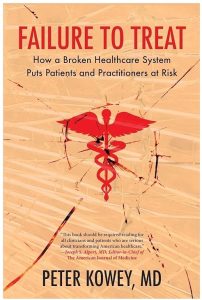
Dr. Kowey wrote the book after witnessing the challenges of the healthcare system not only as a physician, but also through conversations with colleagues and mentors who experienced the system as patients.
Rather than writing a technical medical critique, he chose to tell twenty real-world stories that illustrate the systemic failures affecting modern healthcare.
Storytelling, he believes, makes these issues accessible to both medical professionals and the general public.
The goal of the book is not simply to expose problems, but to spark conversations about how healthcare systems can change before these failures become even more widespread.
A Call for Policy Change
While healthcare reform is often debated at the national level, Dr. Kowey emphasizes that meaningful change may begin closer to home.
Local and state policymakers play a crucial role in determining how healthcare resources are allocated, especially in rural communities.
Better dialogue between policymakers, healthcare professionals, and communities could help reshape systems in ways that prioritize patient care rather than administrative efficiency.
Because ultimately, healthcare is not just about institutions or policies – it is about people.
Also Read: