About this episode
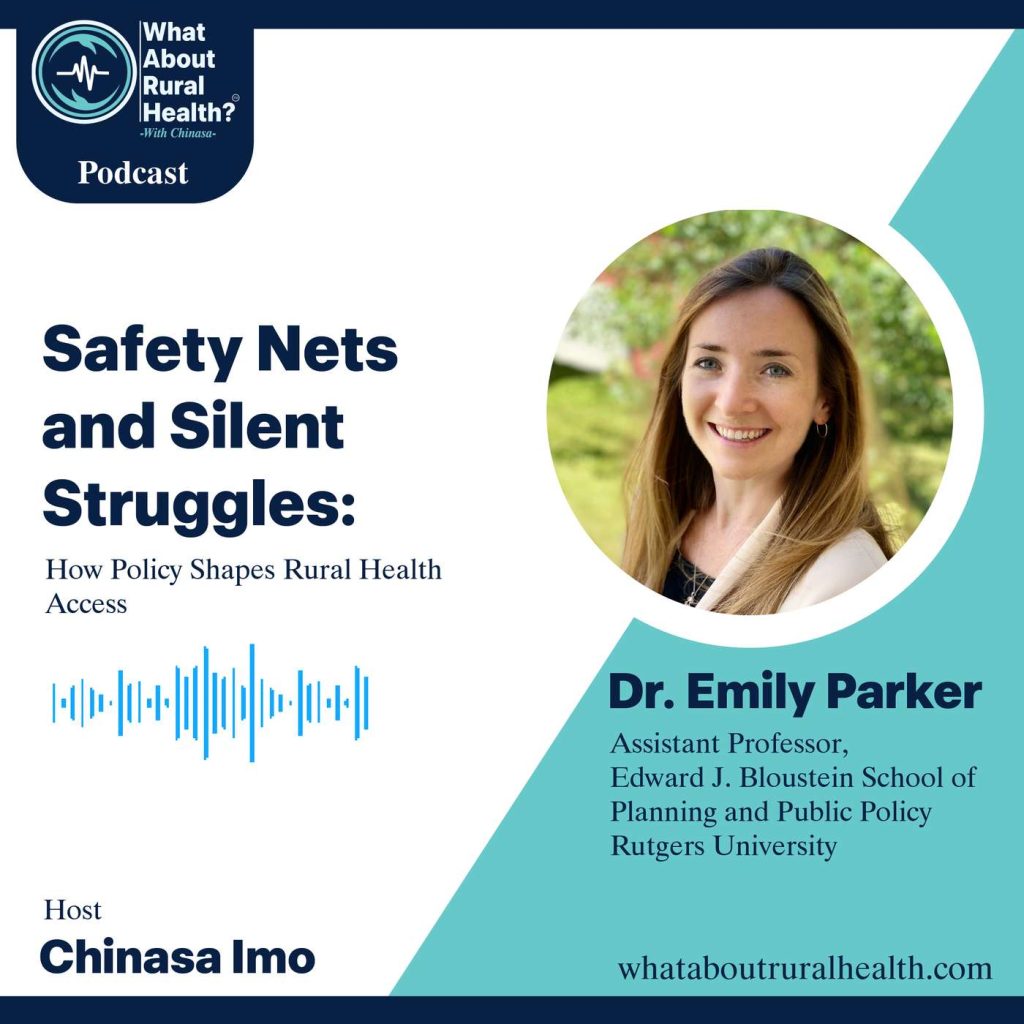
Rural health policy access determines whether people in underserved communities can find, afford, and sustain the care they need. In this episode of What About Rural Health?™, Dr. Emily Parker joins host Chinasa Imo to examine how safety-net programs, place-based policy, telehealth, immigration rules, and public infrastructure shape rural healthcare access.
The conversation moves beyond the idea that rural health disparities are caused only by a shortage of hospitals or clinicians. Dr. Parker explains how administrative systems, eligibility rules, transportation, broadband access, local economic conditions, and awareness of public benefits can determine whether care is truly available. Policies designed without rural realities in mind can unintentionally deepen inequity, even when the stated goal is universal access.
This episode offers a practical framework for understanding why rural communities need policies built around place, population, and lived experience.
Why do safety-net policies matter in rural healthcare?
Healthcare safety nets help protect people who might otherwise be excluded because of income, insurance status, geography, disability, immigration status, or limited local services. In rural areas, these protections are especially important because residents may have fewer providers, longer travel distances, limited public transportation, and less access to specialized care.
Dr. Parker traces how safety-net programs developed and why their design still matters. A benefit may exist on paper but remain out of reach when enrollment is confusing, offices are distant, language support is limited, or residents do not know they qualify. Effective rural health policy must address both formal eligibility and the practical path people must follow to receive care.
What is place-based rural health policy?
Place-based policy uses geographic, demographic, and economic conditions to design more responsive interventions. Instead of assuming that the same program will work equally well everywhere, it asks what barriers exist in a particular community and what resources are already present.
For rural health, this can include funding formulas that account for distance and low population density, support for rural hospitals and clinics, mobile services, community health workers, transportation assistance, broadband investment, and incentives that strengthen the local workforce. Place-based approaches also recognize that rural communities are diverse and that solutions must be shaped with residents rather than imposed from outside.
How do administrative burdens limit access to care?
Forms, documentation requirements, eligibility reviews, fragmented referrals, and changing rules can create an invisible barrier between patients and services. These administrative burdens are harder to overcome when people have limited internet access, cannot take time away from work, lack transportation, or need language assistance.
The episode highlights the importance of clear communication about rights and entitlements. Immigrant families and other underserved populations may avoid seeking support when they are uncertain about eligibility or fear consequences. Trusted community organizations, navigators, and culturally responsive outreach can help people understand available services and complete the steps required to access them.
Can telehealth close rural access gaps?
Telehealth can connect rural patients with primary care, behavioral health, specialists, follow-up visits, and health education. It can reduce some travel and make limited clinical capacity go further. However, telehealth is not automatically equitable.
Reliable broadband, affordable devices, accessible platforms, digital literacy, privacy, reimbursement, and local referral pathways all influence whether virtual care works. Telehealth policy should therefore be linked to wider investment in rural infrastructure and in-person services. Digital care is most effective when it expands choice and continuity rather than becoming the only option available.
About the guest
Dr. Emily Parker brings a policy-focused perspective to healthcare access, safety nets, and the structural conditions affecting rural and underserved communities. In this conversation, she connects the history of public policy with current questions about place-based investment, administrative access, immigrant inclusion, and digital health.
Who should listen?
- Rural health policymakers and government leaders
- Public health professionals and health equity advocates
- Rural hospitals, clinics, and community health centers
- Social workers, patient navigators, and community health workers
- Telehealth and digital health teams
- Researchers and students studying rural policy or healthcare access
- Community organizations serving immigrant and underserved populations
Frequently asked questions
What is a healthcare safety net?
A healthcare safety net is the collection of programs, providers, and protections that helps people receive care when cost, insurance status, geography, or social conditions would otherwise prevent access.
Why does place-based policy matter for rural communities?
Rural communities differ in population density, infrastructure, workforce capacity, distance from services, and local economies. Place-based policy uses these conditions to design funding and services that match actual community needs.
What are administrative barriers to healthcare?
Administrative barriers include complicated applications, documentation requirements, fragmented systems, unclear eligibility rules, limited language access, and repeated enrollment processes that make benefits difficult to obtain.
What must accompany telehealth expansion?
Telehealth expansion works best with reliable broadband, affordable technology, digital literacy support, privacy protections, fair reimbursement, accessible platforms, and strong connections to local in-person care.
Key topics and search terms
Rural health policy access, rural healthcare safety net, place-based health policy, rural health disparities, telehealth policy, healthcare access for immigrants, social determinants of health, rural broadband, administrative burden, underserved communities, health equity policy, and rural healthcare infrastructure.
What are the main takeaways?
Rural healthcare access is shaped by much more than the number of clinicians or facilities. Policy design, program administration, transportation, broadband, affordability, and public awareness all affect whether people can use available services.
Strong rural health policy starts with local realities. Safety-net programs must be understandable and reachable, telehealth must be supported by infrastructure, and rural residents must have a meaningful role in designing the systems intended to serve them.
Resources
- Explore more episodes of What About Rural Health?™
- Learn more about host Chinasa Imo
- Share your rural health story: info@whataboutruralhealth.com
About What About Rural Health?™
What About Rural Health?™ is a global platform for rural health equity, using conversations, digital storytelling, advocacy, and collaboration to bring rural healthcare challenges and solutions into public and policy discussions.
Work with What About Rural Health?™
For partnerships, speaking, sponsorship, research collaboration, or story submissions, email info@whataboutruralhealth.com. You can also support the work of What About Rural Health?™.